

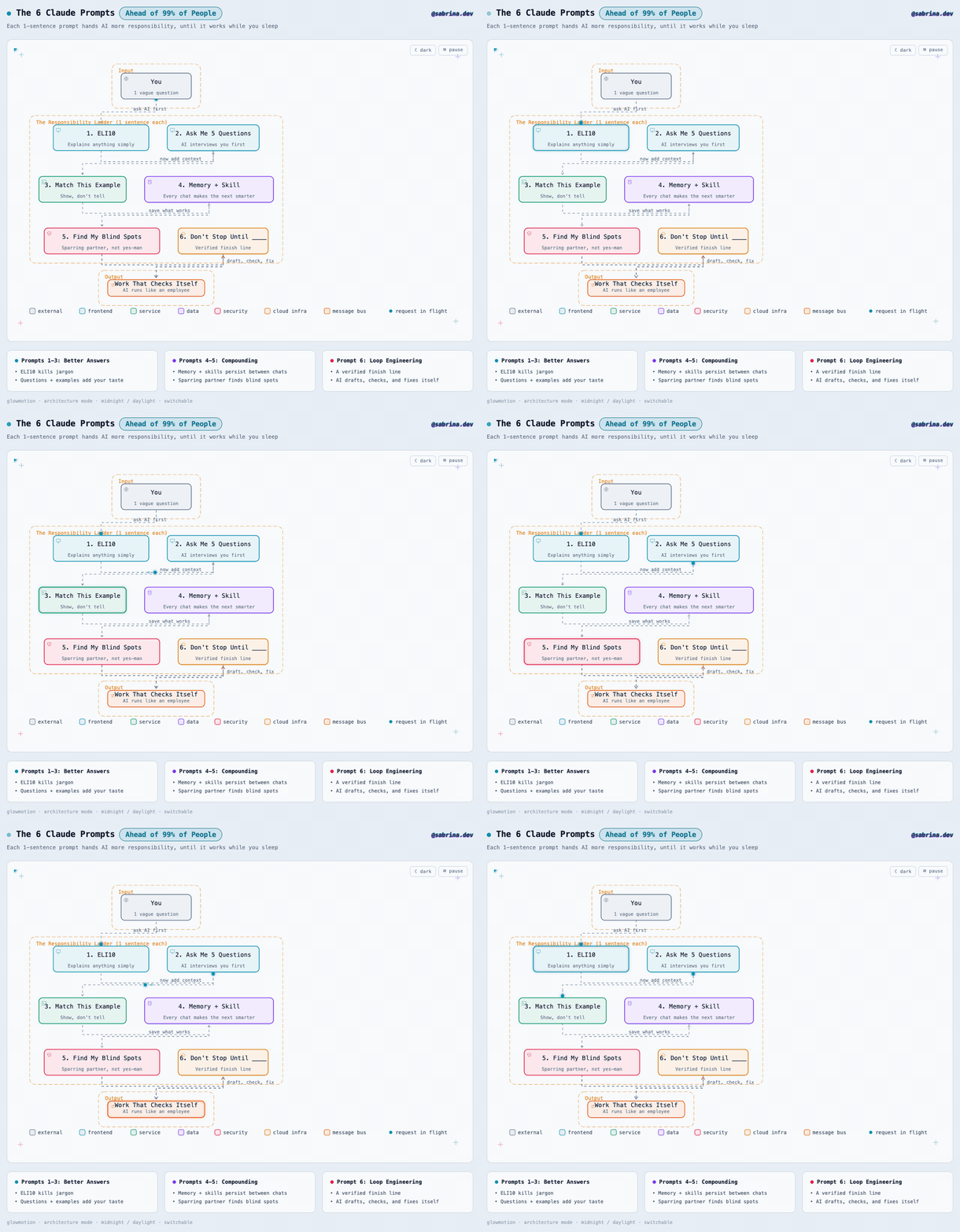
99% of people still prompt like “make it better.”
Type question, grab answer, walk away. Like a vending machine.
Then they wonder why their results feel generic while someone else saves 30+ hours a week with the SAME tool.
The difference isn’t the tool.
It’s not a $5,000 course either!
It’s 6 tiny prompts, each 1 sentence long, each handing AI more responsibility than the last. By #6, AI is working reliably while you sleep.
To show you, I’ll run ONE example through all 6: say you’re a designer trying to land your 1st paying client for your business.
Watch AI grow from confused & generic… into a pitch machine that checks itself.
1. “ELI10”
ELI10 how do I start a business?
Paste “ELI10” anywhere in your prompt and Claude/ChatGPT breaks the answer down in simple terms.
Let’s say you want a side income, but the first steps are jargon: LLCs, invoices, “net-30” payment terms, contract fine print.
Old you: nod along in confusion, or give up before you start.
New you: paste the confusing thing into Claude/ChatGPT, type ELI10, and 3 minutes later you actually GET it.
Here’s my challenge for you: for the next 2 weeks, EVERY SINGLE QUESTION you have, ask AI FIRST before you act on the impulse to ask a person or complain or feel flustered.
AI is your personal 24/7 tutor: infinitely patient, never condescending, never annoyed you asked ten times.
The principle: ask AI first. When answers are free, fast, and judgment-free, curiosity should be your default instead of your last resort.
Now AI can explain anything TO you. But it still knows nothing ABOUT you.
2. “Ask me 5 clarifying questions”
Before you answer, ask me 5 clarifying questions.
Time to pitch. You type “write a pitch for my design services”… and get the same generic template as everyone else.
Vague question in, AVERAGE assumptions out.
Add this 1 sentence, and AI interviews you first: Who’s your dream client? What result have you delivered before? What’s your price? Why you?
Answer, and the generic template becomes YOUR pitch: your niche, your proof, your price.
But here’s the sneaky part…
The questions expose gaps in your OWN thinking. You never actually picked a niche, did you?? :D
The principle: context is everything. AI’s answer is only as good as what you feed it, and a real thinking partner interviews you first.
So the pitch finally has your ingredients. It just doesn’t SOUND like a winner yet.
3. “Here’s an example of what great looks like”
Here’s an example of what great looks like: [paste it]. Match it.
You found a freelancer sharing the exact proposal that won them a real client: short, specific, opens with the client’s problem, 1 proof point, clear next step.
Don’t describe it to AI. Paste it.
“Match this” beats 100 adjectives like “professional” or “compelling.”
This is the oldest trick in prompting, and in 2026 it’s STILL the highest-leverage one. Anthropic’s own prompting guide pushes EXAMPLES harder than any other technique.
And it works way beyond pitches: paste your best email, your favorite resume, the post that got the most engagement. Show AI your best, and it gives you more of your best.
So your pitch just went from sounding like a template… to sounding like the person who actually wins clients.
The principle: show, don’t tell.
But here’s the catch: next client, you start from zero again.
UNLESS…
4. “Update your memory and create a skill”
Imagine hiring 5 brilliant people and re-explaining your entire business to EVERY one of them, EVERY morning.
That’s what starting a fresh chat with zero context is.
There are 2 ways to fix it, and I use both.
Option 1: have AI update its own memory.
Based on this conversation, what are the most important things you should remember about me and my goals? Save them to memory.
AI saves everything you taught it in prompts 2 and 3: your niche, your services, your proof point, your price, the pitch structure that works. Both ChatGPT and Claude have memory. Almost nobody deliberately maintains/curates them.
My favorite trick: make AI maintain its own brain at the end of every useful conversation.
Option 2: have Claude turn the conversation into a reusable skill.
Create a skill so I don’t have to repeat what I said.
Claude analyzes what you just did together, spots the repeatable process, and packages it up. The next pitch - and the 10 after that - is 1 command instead of 20 messages: paste the job posting, get YOUR pitch in YOUR winning format.
And please don’t download those packs of 30,000 generic AI-generated “skills” floating around.
Mine your OWN conversations.
That’s where the skills worth keeping come from.
Memory is for facts about you. Skills are for processes you repeat.
The principle: compounding. Every conversation should make the NEXT one smarter, so your AI gets more valuable every week while everyone else’s stays dumb.
Prompts 1-4 built you a client-getting machine.
Now find out where it’s WRONG…
5. “Find my blind spots and weak assumptions”
Find my blind spots and weak assumptions.
By default, AI is a yes-man.
Show it your plan to land 3 clients this month and it says “Great plan! You’ve got this!”
I call this the glazing partner.
It makes you feel good and helps you - NOT AT ALL.
I use AI as a SPARRING partner instead. Rip my plan apart. Argue with me. Why am I wrong?
Suddenly: your price is so low it signals “cheap,” not “great deal.” Your target client is “everyone,” which means nobody. And your pitch promises results you have zero proof you can deliver.
Then I push further:
What would you need to see to be convinced this plan works?
Now AI isn’t just poking holes… it’s handing you a checklist that separates a real plan from a hopeful one.
The principle: embrace AI as your sparring partner. The best use of AI isn’t confirming you’re right… it’s finding where you’re wrong BEFORE reality does.
You caught the flaws by ASKING. The final step: AI catches them without you asking.
6. “Don’t stop until ____”
The most advanced one. Saved for last on purpose.
Don’t stop until [outcome], verified by [a check AI can actually run].
Most people prompt, read, re-prompt, read again… THEY are the loop.
But this technique removes you from the loop.
For our designer’s pitch:
Don’t stop until the pitch is under 150 words, opens with the client’s specific problem, includes exactly 1 proof point, and ends with a clear next step. Check every rule before showing me.
Notice what happened: the checklist from prompt 5 just became the finish line.
AI drafts, checks, finds the pitch is 210 words with no proof point, fixes it, checks again… and only shows you the version that passes every rule.
In Claude Code, this is literally built in: the `/goal` command. My loop engineering guide even runs a 24/7 A/B test on outreach messages as project #5. It uses a DIFFERENT model to check the work is complete, in order to reduce AI lying to you.
The magic word is VERIFIED.
“Make it good” is not checkable. “Under 150 words with 1 proof point” is. Without a check, AI either stops too early or loops forever guessing.
Don’t expect 1 pass to clear the bar. AI will grind through 2-3 rewrite rounds on its own… and that’s the whole point! You didn’t have to prompt it each round.
This is the essence of “loop engineering”. This is what truly differentiates 10x more productive AI users from everyone else.
Fun fact: this newsletter was reviewed with a “don’t stop until the grader scores it 9+” goal. The loop you just read about edited the thing you’re reading! meta :D
The principle: loop engineering. Give AI a finish line plus a way to check itself, so that YOU get OUT of the loop.
My Honest Pick
If you only steal 1 prompt, steal #6.
The other 5 make you better at working WITH AI.
#6 makes AI work WITHOUT you.
But notice the pitch only wrote itself because of everything before it: understanding (1), context (2), taste (3), memory (4), and a checklist of flaws to guard against (5).
That’s the actual gap between the 99% and the 1%. Not fancier prompts… fewer prompts, clear finish lines.
Start with ELI10 today.
Work down this list on something real: your side business, your resume, your next big ask.
Not Sure Where To Start? 👇
I’ve organized my best trainings below:
Subscribe to my Youtube and hit the “notification” bell
So that you never miss my free trainings 👇
Attention! This AI Guru and Knowledgeable Business Woman, will teach you Everything!!!! Follow Her🙌
Thank you, Sabrina. I look forward to trying these out, especially #6. I get tired of prompting Chat or Claude (I use both) to try again.