

TLDR: AI SEO, also called AEO or answer engine optimization, is how you get your brand named inside ChatGPT, Claude, Perplexity, and Google AI Overviews. Old SEO won you a blue link. AI SEO wins you a mention in the answer. Here’s the full playbook, beginner to advanced, with copy-paste prompts for every step.
Right now, someone in your target audience is typing your category into ChatGPT.
They’re not typing “best project management software.”
They’re typing 4 sentences about their team, their budget, and their deadline.
And AI gives them 3 names.
If you’re not 1 of those 3 names, you don’t get a second chance.
There’s no page 2 to scroll to.
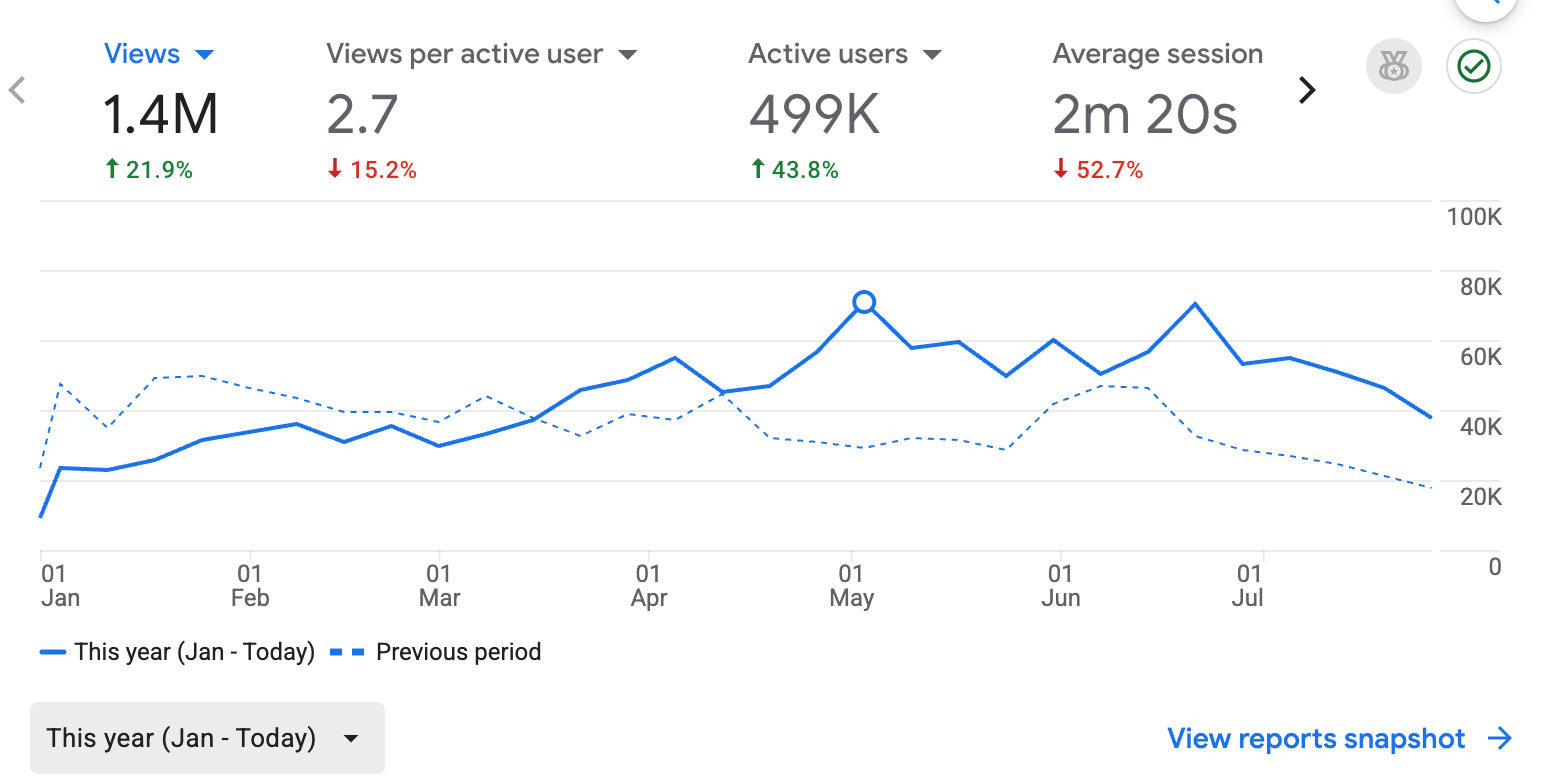
I run blotato.com. This year alone 1.4M views:
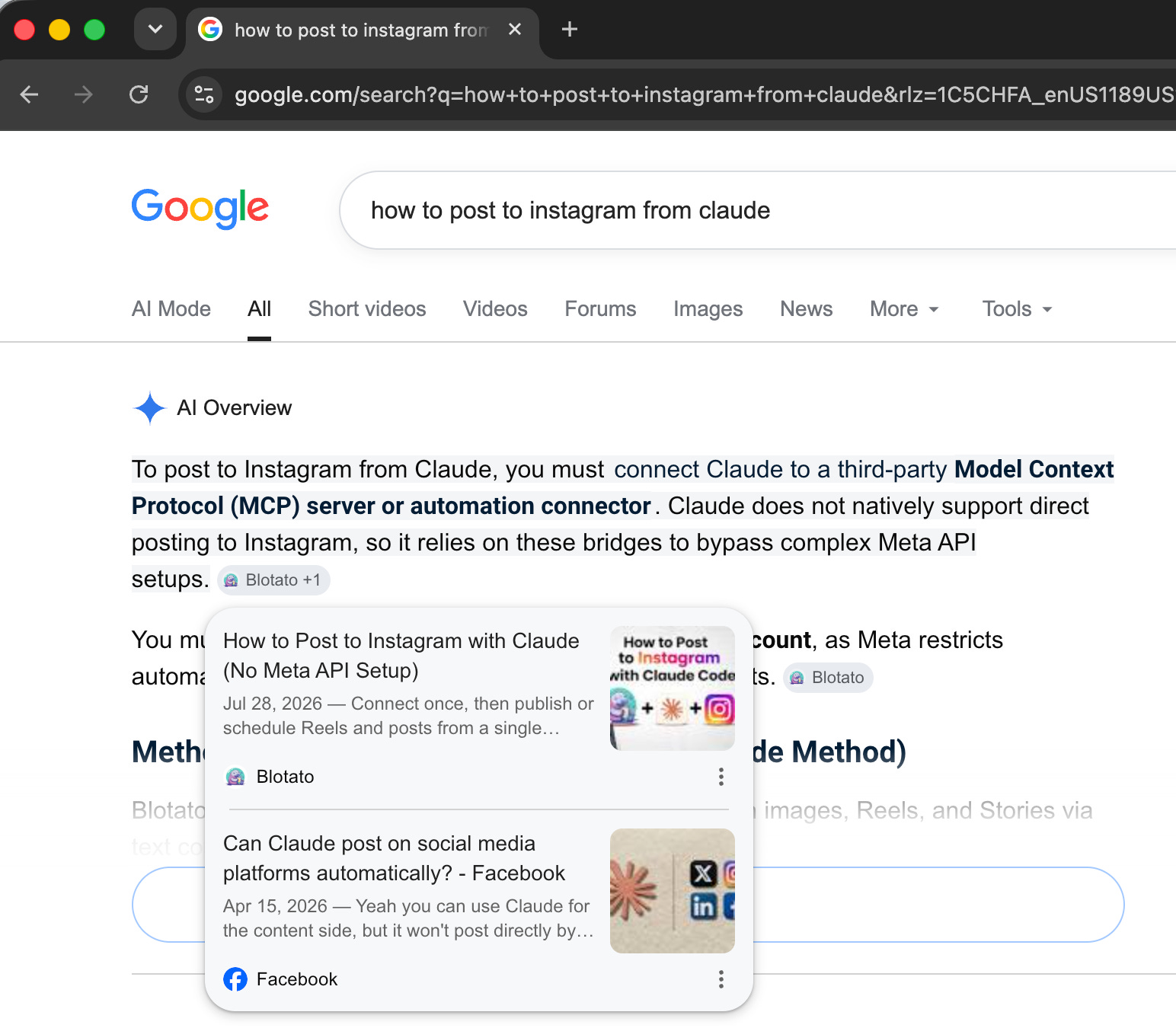
Here’s Blotato appearing in the top spot in a Google AI Overview about “posting to instagram from claude”. I opened a fresh browser in incognito mode. Try it yourself :)
By the end of this email, you’ll know exactly what to do and how to charge other people if you want to sell this as a service.
I’m going to walk you from “I don’t know what SEO means” to “I have a system running.”
Beginner, then intermediate, then advanced.
Every section ends with a prompt you can paste straight into ChatGPT or Claude, so you’re not just reading. You’re DOING!
Let’s start with the basics…
Watch the full livestream here:

1. What Is SEO?
SEO stands for search engine optimization. It means making it likely that a search engine shows YOUR page to someone looking for what you sell.
For years, the game had a simple shape. Someone types a question into Google. Google shows 10 blue links. You want to be near the top of those 10, because the top gets the clicks.
So everyone optimized for that shape. Put the right words on the page. Get other websites to link to you. Make the page load fast. Climb the list.
The reward was TRAFFIC.
Rank higher, get more clicks, get more customers.
Every piece of SEO advice was built on 1 assumption:
The person will click.
That assumption just BROKE :D
2. What Is AI SEO (AEO) And How Is It Different From SEO?
AI SEO, also called AEO or answer engine optimization, is getting your brand named INSIDE an AI’s answer instead of ranking as a link below it.
When someone asks ChatGPT or Claude or Perplexity a question now, they don’t get 10 links.
They get an ANSWER. A short one.
With maybe 3 brands named inside it.
And they usually stop there. Most AI chat sessions end without the person clicking through to any website at all.
If nobody clicks, then ranking #1 is worth nothing by itself. The prize isn’t the click anymore.
The prize is being mentioned in the answer.
Here’s the difference side by side:
What you win. Old SEO: a blue link on a results page. AI SEO: your brand name inside the written answer.
The goal. Old SEO: rank in the top 10 links. AI SEO: get cited as 1 of 3 recommended options.
How you win it. Old SEO: keywords, backlinks, page speed. AI SEO: consistent facts about you across many sites.
What the reader does. Old SEO: clicks, then compares options. AI SEO: reads the answer and stops.
What you measure. Old SEO: clicks and sessions. AI SEO: how often you get named, and signups.
Who it favors. Old SEO: big sites with long histories. AI SEO: anyone described the same way in many places.
And this isn’t a small niche of weirdos. G2 surveyed 1,076 business software buyers in 2026 and found 51% now START their research in an AI chatbot more often than in Google.
1 year earlier that number was 29%.
So if you sell anything, half your future buyers are forming their first impression of you inside AI chat.
That may sound like bad news for you…
But it’s the opposite, and 1 number explains why.
Subscribe to my Youtube and hit the “notification” bell
So that you never miss my free trainings 👇
3. Why Is AI SEO Good News For Businesses?
Because AI traffic is tiny but converts far better than search traffic, which means a small site named in a few answers can outperform a big site with lots of visitors.
Ahrefs published their own website data and foundL
AI search sent them just 0.5% of their total traffic
That tiny sliver produced 12.1% of their signups.
Fewer visitors.
WAY better visitors.
That makes sense when you think about what the person just did. They described their exact situation to an AI. They got a shortlist. They compared options. They read about weaknesses.
By the time they land on your site, they’ve already done the work. They’re not browsing. They’re deciding.
So a small site that gets named in 20 answers can beat a giant site that gets 100,000 random visitors.
That’s the opening. Big companies move slowly.
Legal has to approve things. 4 people have to sign off on a comparison page.
Most of them will never publish a page that names a competitor.
You can publish 1 tomorrow.
Speed is the ONLY advantage you need, and it starts with the single cheapest thing on this list.
4. Beginner: What Is The 1 Thing You Want To Be Known For?
Start here because it takes 5 minutes and it’s the 1 page about you that you fully control.
LinkedIn profiles get read by AI models constantly. They’re public, they’re structured, they’re written in plain language, and they say who a person is.
When an AI is deciding whether you’re credible enough to name, your LinkedIn is one of the TOP things it looks at and trusts.
Most people write a headline like “Founder | Cat Lover.”
That tells a machine NOTHING.
Here’s mine:
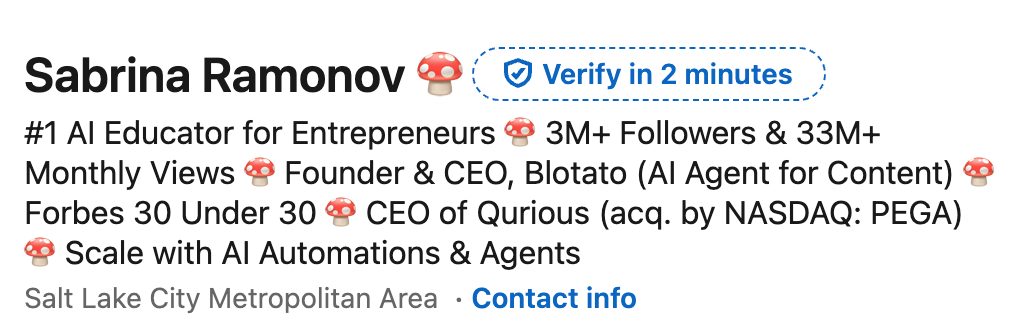
Look at the first 5 words. Not my job title. Not my company.
“#1 AI Educator for Entrepreneurs.”
That’s the 1 thing I want to be known for.
Everything after it exists to prove that claim is true:
3M+ followers
33M+ monthly views
Founder of Blotato
Forbes 30 Under 30
Previous company acquired for millions
So the structure is:
[The 1 thing you want to be known for] + [proof it’s true] + [proof it’s true] + [proof it’s true]
Most people do this backwards. They lead with their job title, which is a fact about their employment, not a claim about their value. “VP of Marketing at Blotato” tells a model where you work.
“#1 email marketing person for ecommerce brands” tells a model what to recommend you FOR.
Picking that 1 thing is the hard part, so let AI do the first pass.
Prompt: Here’s my background: [paste your resume, bio, or just describe what you do and who you help]. Based on this, suggest 5 options for the 1 thing I could realistically be known for. Each should be a specific claim about the value I provide to a specific group of people, not a job title. For each option, list which of my actual credentials would prove it and tell me which claim I have the most evidence for right now.
Then paste it into your LinkedIn headline field before you close this email. Not later. Later means never, and this is the only step everything after it depends on.
Write it in normal words.
Not “synergistic growth architect.” This was called “slop” before the term “AI slop” :D
Just say THE THING.
Go change it right now. Seriously, open LinkedIn right now!!
Because once you’ve written that 1 claim, you’re going to need it in a lot more places…
5. Say The Same Thing Everywhere
Here’s the part almost everyone gets wrong.
They write a good description on their website. Then their Twitter bio says something different. Then their listing on a directory says a third thing. Then an old profile from 2 years ago says a fourth.
AI reading all of that gets a fuzzy picture.
Fuzzy means it won’t risk recommending you.
A model isn’t looking up a fact about you in a database. It’s noticing which words keep showing up next to your name across the whole web.
If “Acme” appears near “email marketing for ecommerce” on 30 different sites, the model treats that pairing as true and repeats it.
If your name appears next to 4 different descriptions, it has nothing confident to repeat. So it names a competitor instead.
Consistency isn’t tidiness.
It’s the actual mechanism.
Before you paste it anywhere, check 1 thing: some hosting setups block AI crawlers by default.
Open your robots.txt and make sure the SEARCH crawlers are allowed. Those are OAI-SearchBot for ChatGPT, Claude-SearchBot for Claude, PerplexityBot for Perplexity, and plain old Googlebot for Google’s AI answers. Those 4 decide whether your pages can be quoted. If the search crawlers are blocked, everything you do on your OWN site is invisible.
Then take the claim you just wrote and paste a version of it into:
Your website’s about page and homepage
Your LinkedIn, X, Instagram, YouTube, and TikTok bios
Software review sites in your category (G2, Capterra, Trustpilot, SourceForge)
Any directory or marketplace that lists businesses like yours
Your email signature
Your podcast guest bio, if you have one
The review site profiles matter more than people think. In that same G2 study, review sites were the #2 source buyers used, right behind AI chatbots.
Check out my Blotato Trustpilot testimonial page for a clear example how to crush this game.
They’re also free.
You just have to fill in the form.
One more thing while you’re there: ask 5 happy customers to leave a review. Real reviews with specific details get quoted by AI far more than a star rating does.
Prompt: Here’s the 1 thing I want to be known for: [paste your claim]. Here are the descriptions of me currently live on my website, LinkedIn, X, and [other profiles]: [paste each one]. Point out every place these contradict each other or describe me differently. Then rewrite each one so they all make the same core claim, adjusted for that platform’s length limit and tone. Keep the exact same key phrase in all of them.
You now have a consistent story about who you are, spread everywhere.
But a profile can only get you MENTIONED.
To get quoted, you need pages built for it.
6. Beginner: Which Pages Do AI Answers Actually Quote?
Comparison pages, “best of” lists, and alternatives pages. Those 3 formats get cited far more than blog posts, because they answer the question the person actually asked.
Not blog posts about “5 tips for productivity.” Not your company history.
These 3:
1. The “best X” list. “Best invoicing software for freelancers.” “Best AI video tools in 2026.” A ranked list of options with a table.
2. The “X vs Y” comparison. “Notion vs Obsidian.” Head to head, feature by feature.
3. The “X alternatives” page. “Best Mailchimp alternatives.” For people who already have a tool and are unhappy.
Why these 3? Because they match what the person is asking. Someone typing “what’s the best X for Y” is asking a comparison question. An AI answering that question wants a source that already did the comparing.
Give it one.
And yes, you can write these about your own category and include yourself. That’s what everyone in the top 3 answers is doing.
The rules if you do:
Be honest. If a competitor is better at something, SAY SO. A page that says you win everything reads like an ad, and models are getting good at spotting ads.
Include the ones that genuinely belong, even the strong ones.
Give real prices, not “affordable.”
Put a table near the top.
Prompt: I sell [what you sell] to [who you sell to]. My main competitors are [list 3 to 5]. Give me a prioritized list of 10 pages I should write, using only these 3 formats: “best [category]” lists, “[me] vs [competitor]” comparisons, and “[competitor] alternatives” pages. Rank them by how likely they are to be quoted by an AI answering a buying question, and tell me which single one to write first and why.
That’s the beginner tier. A clear claim about you, repeated everywhere, plus 3 pages built in the shape AI wants.
Now the intermediate work, which is where most people stall out. Because you can’t write a great comparison page until you know what people are actually asking.
7. Intermediate: How Do You Find The Questions Buyers Actually Ask?
Pull them from your own sales calls, support tickets, and reviews. Those are the exact words your buyers use.
DON’T GUESS! DON’T PRESUME YOU KNOW BETTER!
The words are already sitting in places you own.
Go mine them:
Sales calls. What do people say right before they buy? What are they moving away from?
Support tickets. What breaks? What confuses people?
Your reviews and your competitors’ reviews. Read the 3-star ones. That’s where the honest complaints live.
Social threads in your niche. Search your category name and read how normal people describe the problem.
Your own inbox. The questions people ask before signing up.
You’re looking for 3 buckets:
Bucket 1, competitor terms. “[Competitor] pricing.” “[Competitor] alternatives.” “[Competitor] vs [other competitor].” These have low competition and high buying intent, because someone searching them has their credit card halfway out.
Bucket 2, problem terms. The specific frustration your thing solves, in their words. Not “workflow inefficiency.” More like “my team keeps missing client emails.”
Bucket 3, fit terms. “Best X for agencies.” “X for small teams.” “X that works with Shopify.”
Skip anything that’s purely educational.
“What is a CRM” brings in students and researchers, and AI answers those questions completely without ever naming a brand.
Now here’s what differentiates this from old keyword research.
When someone asks an AI a long question, AI doesn’t run 1 search.
It quietly breaks the question into several smaller ones and searches each. Somebody asking “what’s the best scheduling tool for a 5-person agency under $50 a month” triggers hidden searches for agency scheduling tools, scheduling tool pricing, small team scheduling, and more.
Every one of those is a door into your page!!!
So you’re not writing 1 page per keyword anymore.
You’re making sure your page can answer every small question hiding inside the big one.
Prompt: My customers are [describe them]. Here are real things they’ve said in sales calls and support tickets: [paste 10 to 20 quotes]. First, turn these into 20 search queries someone would actually type when they’re ready to buy, sorted into 3 buckets: competitor terms, problem terms, and fit terms. Then take my top 5 queries and, for each, list the 5 smaller sub-questions an AI would need to answer in order to answer the full question. Skip anything purely educational with no buying intent.
Boom, that’s your SEO plan for the next 3 months.
Now you know WHAT to write about.
The next part: can a machine can actually use what you wrote?
8. Intermediate: How Do You Format A Page So AI Can Quote It?
Break it into chunks that make sense alone. An AI grabs 1 passage from your page and drops it into an answer, with none of the surrounding context.
So every chunk has to stand by itself.
Here are the 5 writing changes, ordered from easiest to biggest difference.
1. Make headings into real questions. Not “Pricing.” Instead: “How much does X cost?” That matches how people ask, so the chunk gets found in the first place.
2. Answer in the first 2 sentences under the heading. Once it’s found, it has about 2 sentences to be useful. Don’t build up to it. Say the answer, then explain.
3. Trade every vague word for a specific one. A useful chunk still gets skipped if it’s mushy. “Cuts editing time from 3 hours to 20 minutes” beats “saves time.” “$29/mo” gets quoted. “Affordable” never does.
4. Say where your info came from. Now that the chunk is specific, it needs to be trusted. One line like “prices checked on each company’s own pricing page in July 2026” does real work, because models weigh visible sourcing.
5. Write table rows that stand alone. AI lifts a single row out of your table with NONE of the surrounding page. So a cell that says “Great for teams” is wasted. A cell that says “Teams of 5 to 20 posting to 8 platforms” can be quoted straight into an answer, which means 1 good table can get you named a dozen times.
This is the test on anything you write…
Cover the whole page except 1 paragraph. Can that paragraph answer a question by itself?
If no, rewrite it.
Prompt: Here’s a page from my website: [paste the text]. Rewrite it so an AI can quote any single paragraph out of context. Turn the headings into the questions people actually ask. Put a direct answer in the first 2 sentences under each heading. Replace every vague phrase with a specific number or fact, and flag anything I need to fill in. Add a comparison table where every single row makes sense on its own. Then write the Organization and FAQ schema markup for this page.
Those 5 changes make the words quotable.
But 3 more jobs make the page findable in the first place:
Job 1: Link your own pages to each other. 5 or more internal links per important page. It helps both Google and the AI work out which of your pages matter.
Job 2: Add schema markup. It’s a small block of code that spells out your facts in a format machines read directly instead of guessing at. The 2 worth doing are Organization schema on your homepage, which states your name, what you do, and your official profile links, and FAQ schema on any page with questions. Most website builders have a plugin. It’s a 20 minute job you do once, and while you’re in there, keep the basics tidy: pages load fast, everything works on a phone, no giant unoptimized images. Unless you have thousands of pages, that’s all the technical work you’ll ever need.
Job 3, the recurring one: refresh what already ranks every 3 months. A page with existing trust flips into AI answers in weeks, where a new page starts from zero. So every 3 months, re-check every price and fact, add anything new in your category, remove tools that died, update the year in the title, and add a fresh example or screenshot.
Prompt: Here’s a page I published on [date]: [paste it]. It’s now [today’s date]. List everything in it that’s likely out of date, every fact I need to re-verify, and every competitor or tool that may have changed or shut down. Then give me a checklist of the 10 specific edits that would make this page most likely to get cited by AI answers today.
That covers everything you control.
Now the part most people never do… (including me i’m super lazy)
9. How Do You Get AI To Mention Your Brand?
It’s simple: Get other websites to name you.
Roughly 85% of the brand mentions AI makes come from sites that are NOT yours, so everything on your own site has a ceiling until outside pages start talking about you.
The free version takes an afternoon:
Ask ChatGPT, Claude, and Perplexity your main category question. Something like “what are the best tools for [thing you do]?”
Write down every article it cites. Those are the pages the AI trusts in your category.
Open each one. Are you on it?
If you’re not, email the author.
The email is short:
Hi [name], I read your piece on the best [category] tools. I run [your thing], which does [specific thing the others on your list don’t]. Happy to send you free access, screenshots, and honest notes on where we’re weak if it’s useful for the next update. No pressure either way.
Some will ignore you. Some will add you. Every single one that adds you becomes a source an AI can quote.
I’ve been getting a lot of emails like this after upping my SEO game, but I personally haven’t started outreach to OTHER sites yet.
Prompt: Here are the articles ChatGPT, Claude, and Perplexity cited when I asked about [your category]: [paste the list of titles and links]. My product is [name] and its genuine advantage over the others on those lists is [specific thing]. For each article where I’m missing, write a short personalized outreach email to the author. Mention something specific from their piece, state my honest differentiator in 1 sentence, and offer free access plus my real weaknesses. No hype, under 120 words each.
Subscribe to my Youtube and hit the “notification” bell
So that you never miss my free trainings 👇
That costs $0 and it works on small sites and mid-size blogs.
For bigger publications, you need a different door. That’s where the advanced tier starts.
10. Advanced: Do Press Releases Help With AI SEO?
Yes, more than almost anything else for the money.
It’s not even expensive. So this is S tier cheat code.
News sites get crawled constantly and carry a lot of weight, so 1 wire release can put your name on outlets you’d never get into by pitching.
You don’t need a journalist to care about you. You need a wire service.
Use EIN Presswire. You write a release, pay a modest fee, pick your industries and countries, and it goes out to their network.
Here’s what happened when Ryan Doser, a top ranked SEO expert, dropped a press release about Blotato social analytics:
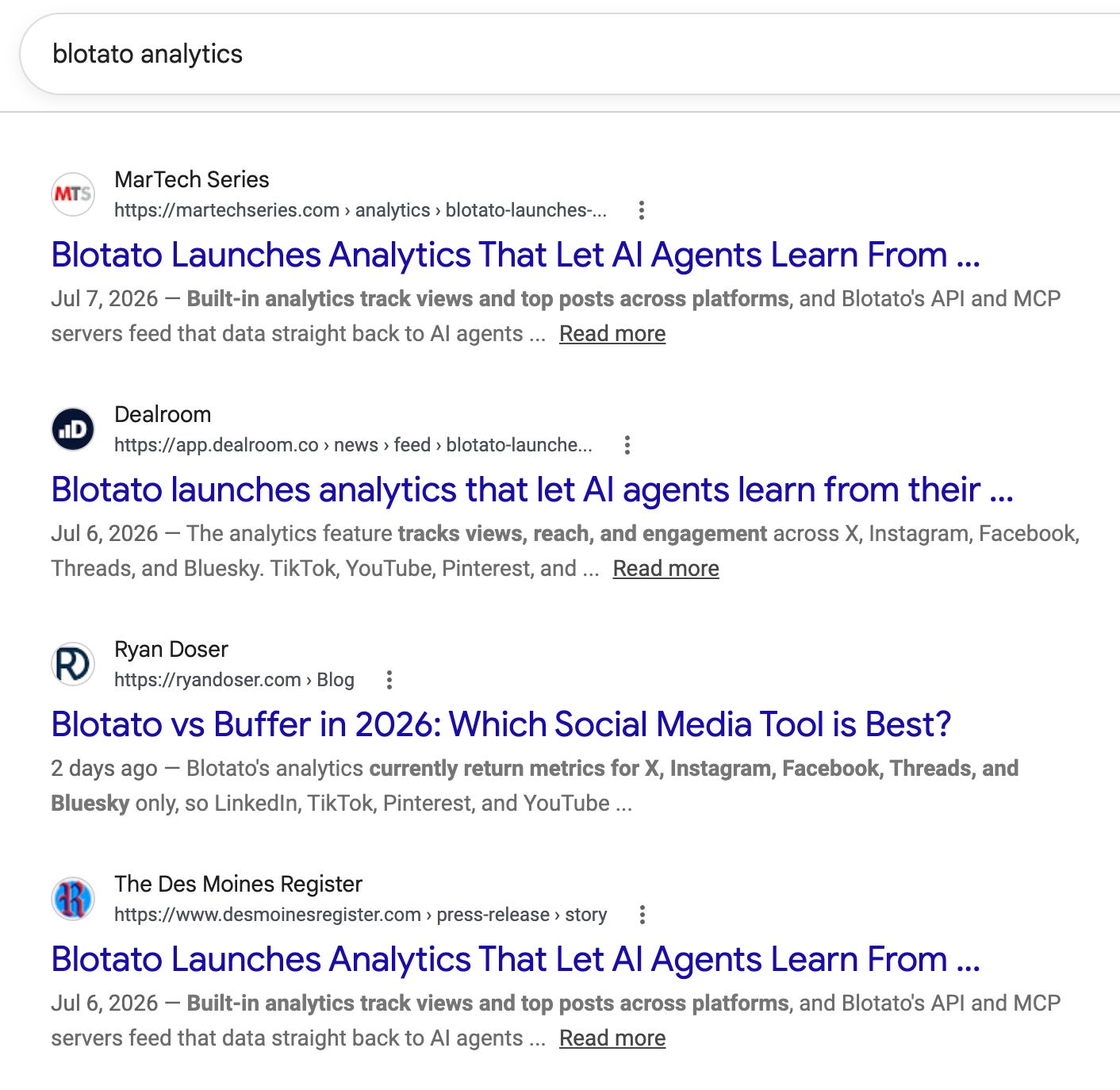
Dealroom picked it up.
MarTech Series picked it up.
The Des Moines Register picked it up.
Here’s the actual release so you can see exactly how it’s written. Read the first paragraph closely. It answers who, what, and why in about 40 words, and it never once says “we’re excited to announce.”
And after that, Blotato started showing up in more AI answers about social media scheduling and analytics.
How to actually do it:
Announce 1 specific notable thing. A launch, a feature, a milestone, a partnership. Not “we’re a great company.”
Front-load the news. First paragraph answers who, what, and why anyone should care.
Write it like a reporter would. Third person, plain facts, 1 quote from you.
Use your link slots on pages that matter. Most services let you link 2 or 3 phrases. Don’t waste them on your homepage. Point them at the pages you actually want quoted, like your pricing page or your comparison page.
Pick your categories carefully. Lead with the industry your buyers live in.
Prompt: Write a 400 word press release announcing [the specific thing]. Write it in third person like a reporter would. The first paragraph must answer who, what, and why anyone should care, in under 50 words. Include 1 quote from me that says something substantive, not “we’re excited.” Here are the facts, and do not add any I haven’t given you: [paste the facts]. Then suggest 3 anchor phrases to link, and which page each should point to, choosing pages I want cited rather than my homepage.
You can run one of these every time you ship something meaningful.
But press release bursts have a ceiling, and here’s where it is.
A press release says your name once, on a date, and then it stops. The next tier says your name on someone else’s domain and never takes it down.
11. Advanced: Get Your Voice On Other People’s Platforms
A podcast episode keeps working. The show notes page sits there with your name on it forever, gets re-crawled every month, and every new episode adds another one. 12 guest spots build 12 permanent pages. That’s why this tier beats the wire service even though the outlets are smaller.
Podcasts. Go to listennotes.com and search your niche. You’ll get hundreds of shows sorted by size. Email the small and mid-size ones. They need guests constantly.
The bigger the show, the better the page.
Here’s my episode on HubSpot’s Marketing Against the Grain, where I walked through how I publish 250+ posts a week solo. Hubspot is a multi-billion marketing company so the fit was perfect.
It’s one of their TOP performing podcast episodes ever.
That 1 episode gave me a page on a major marketing brand’s website, with my name, my company, and a link, sitting on a domain that AI models already trust.
You cannot buy that placement.
You must become INTERESTING / VALUABLE ENOUGH to get invited.
Same move on YouTube, and it’s the one you don’t have to wait to be invited to. Guest on channels in your space, or just make your own videos targeting the buying questions from section 7.
That’s the difference between this tier and everything before it.
A podcast page needs someone to say yes. A YouTube video needs nobody’s permission, and you can publish one this week.
Prompt: I’m an expert in [your topic] and my audience is [who]. Here’s my background: [paste bio]. Find me 10 episode angles that would genuinely interest a host, not just promote me. For each, write a 100 word pitch email with a specific episode title, 3 talking points, and 1 surprising thing I could say that their audience hasn’t heard. Rank them from easiest to hardest show to get booked on. Then tell me which 3 of those angles I could film as my own YouTube videos this week without waiting for anyone to say yes.
By now you might be doing the math on how much writing this is. That’s the real reason people quit. So let’s fix that part.
12. Advanced: Turn It Into a Claude Skill
A skill is just a markdown file with instructions.
Claude reads it and follows it every time.
Same structure, same quality bar, same formatting rules.
Here’s a cleaned-up version of the one Ryan made me for listicles. Copy it into a file, put it in your .claude/skills/ folder, and adapt the brackets to your business.
---
name: listicle-writer
description: Write a "best [category] tools" article built to be quoted by AI answers and rank on Google. Use for roundups, alternatives pages, and category lists.
---

# Listicle Writer

## Before writing

1. Check each tool's OWN pricing page for current prices. Never use a price
   from memory. If a page loads prices with JavaScript, screenshot it and
   read the number off the image.
2. Search the main question in ChatGPT, Claude, Perplexity, and Google.
   Note which articles get cited and what they cover.
3. Read real reviews on review sites and Reddit. Pull 1 genuine strength
   and 1 genuine weakness for every tool.
4. Take a screenshot of each tool's homepage or product.

## Structure

- Intro, 3 to 4 sentences. Open with the problem or a real result, never a
  definition. No "in this article I'll cover." Name your top pick in the
  first 100 words.
- Comparison table immediately after the intro. Columns: Tool, Best For,
  Starting Price, Key Strength.
- H2: "What to look for in a [category] tool" with 3 to 5 criteria.
- H2 containing the main phrase, then one H3 per tool:
  screenshot, 3 to 4 sentences, then "Best for", "Pricing", "Free trial",
  and "Bottom line" each on its own line with a blank line between them.
- H2: "How I evaluated these tools." List the criteria. End with 1 sentence
  naming your evidence, e.g. "prices verified on each company's pricing
  page, strengths and gaps drawn from public reviews and my own testing."
- H2: "How to choose" with a short decision guide by use case.
- H2: "Final recommendation." 2 to 3 sentences, 1 clear pick.

## The quotable-row rule

An AI lifts a single table row with none of the surrounding page. Every
cell must stand alone.

- "Best For" = a specific person or job ("Solo creators posting to 8+
  platforms"), never a bare feature ("Scheduling").
- "Starting Price" = a real figure with a unit ("$29/mo"), never
  "affordable."
- "Key Strength" = one complete clause a reader could act on.

Apply the same test to every paragraph: cover the rest of the page, and
the paragraph must still answer something on its own.

## Quality rules

- Every tool must genuinely belong. Cutting a real contender to make your
  pick look better destroys trust and gets caught.
- Proportional coverage. Don't give your own tool 4x the words.
- Honest verdicts. Name a real weakness in your own pick. If a competitor
  wins at something, say so plainly.
- Low promotional density. Mention your own product where it's the honest
  answer, not in every section.
- Vary the structure between entries so it doesn't read like a template.

## Links and markup

- 3 to 6 internal links to your own related pages, with descriptive anchor
  text.
- 5 to 7 external links inside sentences, never a "sources" list at the
  bottom. Link each tool's homepage on first mention and its pricing page
  on the first pricing claim.
- Put your own main call to action in the first 25 to 30% of the article by
  word count, not at the end.
- Output FAQ schema markup for any question section on the page.

## Style and length

1,800 to 2,800 words. Contractions always, numbers as digits, no em dashes,
one currency, no hype words (revolutionary, transformative, seamless, robust).

## Before publishing

Re-verify every number against a live page, and check that each table row
still makes sense with the rest of the page covered up.
The point is that the rules live in a FILE instead of in your head.
Once the writing is systematized, you’ll publish more than you can keep track of.
And the number you’ve been trained your whole career to watch is now the wrong one.
13. Advanced: How Do You Track If AI Is Recommending You?
Ask the AI models your buyers’ questions every month and log whether you got named.
That count, not traffic, is your scoreboard now.
There are paid trackers that watch your mentions across every model for you, and they’re worth buying once you’ve started building the SEO foundations in all previous 12 steps.
Until then, do it by hand, because the manual version teaches you which questions actually matter and the USER EXPERIENCE of a customer.
Remember the crawler check from section 5? Re-run it now, because a blocked crawler is the 1 thing that makes this scoreboard read zero for reasons that have nothing to do with your value.
Once you know you’re readable, measure these 3 things, in this order.
1. Ask the AIs yourself, monthly. Write down 10 questions your buyers would ask. Paste each one into ChatGPT, Claude, Perplexity, and Google’s AI answers. Log whether you got named, and which competitors did. That spreadsheet IS your ranking report now.
2. Watch searches for your own name. Getting named leads somewhere specific: people go look you up. So in Google Search Console, track how many people search your brand name.
3. Count signups, not sessions. Brand searches tell you they looked. Signups tell you it paid. Tag where people come from, because a trickle of AI traffic that converts beats a flood that doesn’t.
Prompt: I sell [what you sell] to [who]. Write the 10 questions my buyers would most likely type into ChatGPT when they’re ready to choose a tool like mine. Make them realistic and detailed, the way a real person describes their situation, not short keywords. Then build me a tracking table with columns for the question, the date, whether my brand was named, which competitors were named, and which sources the answer cited.
One honest expectation before you start.
This takes TIME, like anything worth doing.
If you know what you’re doing, sure results can show up fast.
But realistically, it varies a lot by how competitive your category is and how much you already had going in.
Anyone promising you results next week is selling something. Every page you publish, every profile you fix, every mention you earn stacks on the last one.
That’s also why it keeps paying long after you stop.
It compounds.
And once you’ve watched it work on your own site, something uncomfortable happens.
You start noticing that almost every business around you is failing at this, and none of them know it yet.
That’s not a coincidence.
That’s THE OPPORTUNITY!
14. Bonus: How To Sell AI SEO To Clients
Everything above is worth money to somebody else.
If you read all this and think to yourself:
“Wow sound amazing… I wish somebody would just do this for me!”
… good news, you are not alone :D
All businesses are watching their Google traffic drop and they don’t know why. Nobody has explained to them the click went away. They’re still paying someone to chase rankings that don’t convert.
You now understand the confusion.
And that’s the whole basis of a consulting offer.
Sell a result, not a service.
Nobody wants to buy “AI SEO.”
It’s an abstract thing they don’t understand anyway.
They want to buy this:
“In 90 days, when your customers ask ChatGPT / Claude who the best [category] in [city] is, your name comes up. Right now it doesn’t. I’ll show you.”
Same work.
Completely different conversation.
The 2nd version has a before state, an after state, and a deadline. That’s what makes it easy to buy.
Use the free audit as your front door.
It takes 20 minutes and you already know how to do it.
Take the 10 questions from section 13.
Run them on the client’s brand across ChatGPT, Claude, and Perplexity. Screenshot every answer.
Then show them the results, with their competitor’s name highlighted and theirs missing.
This is called AGITATING THE PAIN POINT!
Make it hurt :)
You don’t have to sell anything after that. The screenshot does it.
Prompt: I’m doing an AI visibility audit for a [type of business] in [location or niche] called [name]. Their competitors are [list]. Write the 10 questions their customers would ask an AI when choosing between them. Then give me a 1 page audit template with a summary line a non-technical owner would understand, a table showing who got named for each question, the top 3 reasons they’re likely missing, and a 90 day plan split into months.
Charge for the full written version. Make it a discussion.
The going rate for a standalone AI visibility audit in 2026 runs from $250 to $2,000, and lighter productized versions sell for a few hundred. Start at the bottom of that band until you have 3 case studies. A paid audit filters out tire-kickers and it pays you to write the proposal, because the audit IS the proposal.
That audit gets sharper every time you run it on the same kind of business, which is the next decision.
Pick 1 industry and stay there.
“SEO for everyone” means starting from scratch on every project.
“AI SEO for dental practices” means your second client takes half the time, because you already know the questions patients ask, the directories that matter, and the review sites in that space.
Your case studies also stack. 3 wins in 1 industry is a reputation. 3 wins in 3 industries is a coincidence.
Once you’ve picked the industry, you can finally price it, because you know how long the work actually takes.
Price it monthly, not hourly.
A clean structure that works:
Paid audit up front to start the relationship (or Free if you’re truly just starting out with no warm business contacts)
Then a monthly retainer for ongoing work
Retainers in this space run thousands of US dollars per month; the more proof you have, the more you can charge
Set expectations with the client: 3 month minimum to see results; this is not about LOCKING the client into a contract they can’t escape (that doesn’t work anyway), it’s about setting expectations upfront
When you set expectations properly, clients don’t panic in week 6.
Deliver in the same order you learned it.
The 3 tiers are already your project plan.
Month 1, the beginner tier. Fix their profiles, make the descriptions match everywhere, build the first comparison page. Fast, visible, cheap for you.
Month 2, the intermediate tier. Mine their sales calls for real questions, build the pages, refresh what already ranks.
Month 3, the advanced tier. Press release, outreach to lists, podcast placements.
Report on the named-in-answers spreadsheet every month, not on traffic. You picked the scoreboard in section 13, so use it with clients too. Watching that sheet go from 0 out of 10 to 4 out of 10 is what gets a retainer renewed.
That plan is what you’re selling.
Here’s the 1 part of it you can’t promise.
Promise what you control.
You control pages published, profiles fixed, mentions earned, and questions tracked.
You do NOT control what a model says on any given day.
Say that out loud, early. Being the consultant who explains the limits is how you keep clients when a competitor promised them the moon and missed.
That’s the offer.
Proof from your own site, a paid audit that sells itself, 1 industry, monthly pricing, delivery in 3 tiers.
RECAP 🍄
If you do exactly 1 thing from this email, do section 4.
Decide the 1 thing you want to be known for, then make it the FIRST words of your LinkedIn headline, with your proof stacked behind it.
It takes 5 minutes. It’s free.
And it’s the seed claim for everything else, because sections 5 through 13 are all just that same claim, repeated in more places, by more people, in more formats, in high-authority outlets.
Here’s the whole playbook summarized:
Beginner: Pick your 1 claim (4). Say it identically everywhere (5). Write comparison, “best of,” and alternatives pages (6).
Intermediate: Mine real buyer questions (7). Format so any paragraph stands alone (8). Get onto other people’s lists (9).
Advanced: Run press releases (10). Guest on podcasts and publish on YouTube (11). Automate the writing with a skill file (12). Track how often you get named (13).
Bonus: Sell it to clients once it’s worked for you (14).
Seeing all 14 in one list makes the real pattern obvious, and it’s the thing I wish someone had told me years ago…
You’re not optimizing a page anymore.
You’re optimizing what the internet AGREES about you.
Even though I’m a “fancy big influencer”, I really did NOT understand SEO until recently.
The big a-ha! for me was when I deliberately crafted my Linkedin headline, then literally watched all the downstream effects of it being cited across the internet. Also when I finally cleaned up Blotato’s Trustpilot and saw the benefits of that instantly.
A model doesn’t rank your website.
It reads your site, your profiles, other people’s lists, a news story, a podcast page, a video transcript, and it looks for the version of you that shows up the most.
Then it repeats that version.
Which means the winner isn’t whoever writes the cleverest page. It’s whoever is described THE SAME WAY in the MOST TRUSTED PLACES.
That’s why a 5-minute headline fix belongs in the same email as a press release.
They’re the same move at different sizes.
I know 14 sections looks like a lot. But I wanted to condense everything I’ve learned about SEO here.
The people winning at this right now aren’t smarter than you.
They just started before you, when it felt too early to matter.
It’s still early. Not for much longer.
So go do the 30-second version right now: open ChatGPT and ask it who the best person is at [whatever you do].
If your name isn’t in that answer, you just found your goal for the next 90 days.
Not Sure Where To Start? 👇
I’ve organized my best trainings below:
Subscribe to my Youtube and hit the “notification” bell
So that you never miss my free trainings 👇
I would just like to say that I have been participating in a high end $$$ AI course over the past 10 weeks and what you are sharing here is an incredible gold mine for those putting it into practice. I've started with Blotado and find your focus on solopreneurs who don't have giant teams really valuable. The value you are providing is extreme and appreciated! Paul
Love the information! What do you suggest for someone to be able to do this if they are just starting to launch their business?