

In case you missed it:
Get my 3-Books Bundle + early whitelabel access
Clip GTA6 livestreams into 10 shorts a day
Automate social media posts with ChatGPT
Here are 14 proven ways to make money with AI.
Before you read them, know that you only need to pick ONE.
Because this is the trap I see over and over:
Someone picks a path, has a rough couple of weeks or months, then sees an 18-year old on Instagram printing money with something shiny and switches.
Then they switch again.
Because the grass is greener on the other side.
Fast forward 1 year, they’ve “tried” 6 things & made $0.
#1 reason people fail is they don’t stick with anything long enough to see it compound.
In most of the failure stories I hear, the person would’ve been fine if they’d stuck with it for longer.
So, pick one and give it a full year without switching.
It’s easier if you start with work you already know how to do, or something you’re curious about. You’ll still hit dead-ends, anxiety, imposter syndrome, stuff will break, you’ll resent me because “it doesn’t work”, some days nothing goes right.
That’s normal btw :)
(at every stage of business iykyk)
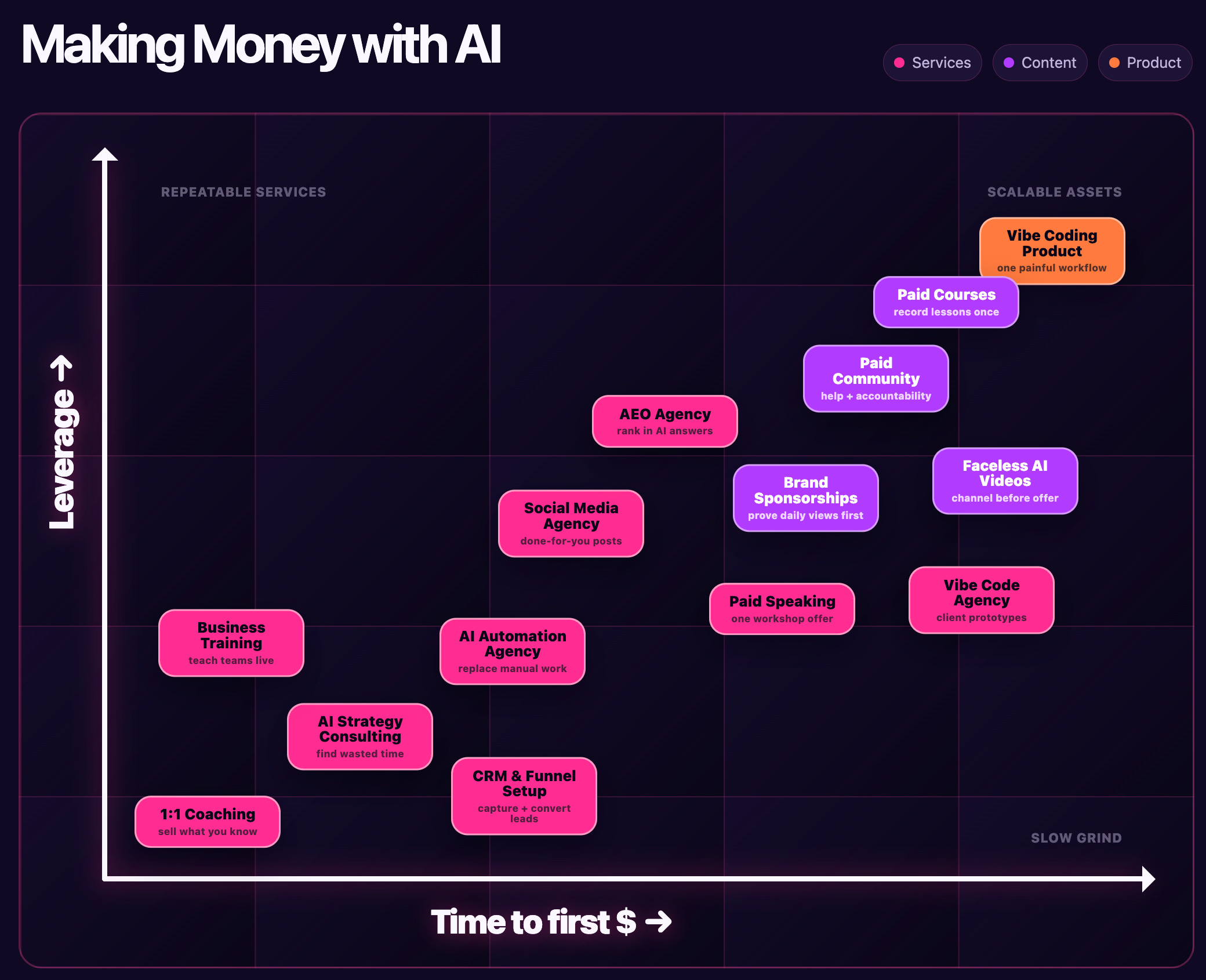
If you want to see all the paths, I put them in my AI money map:
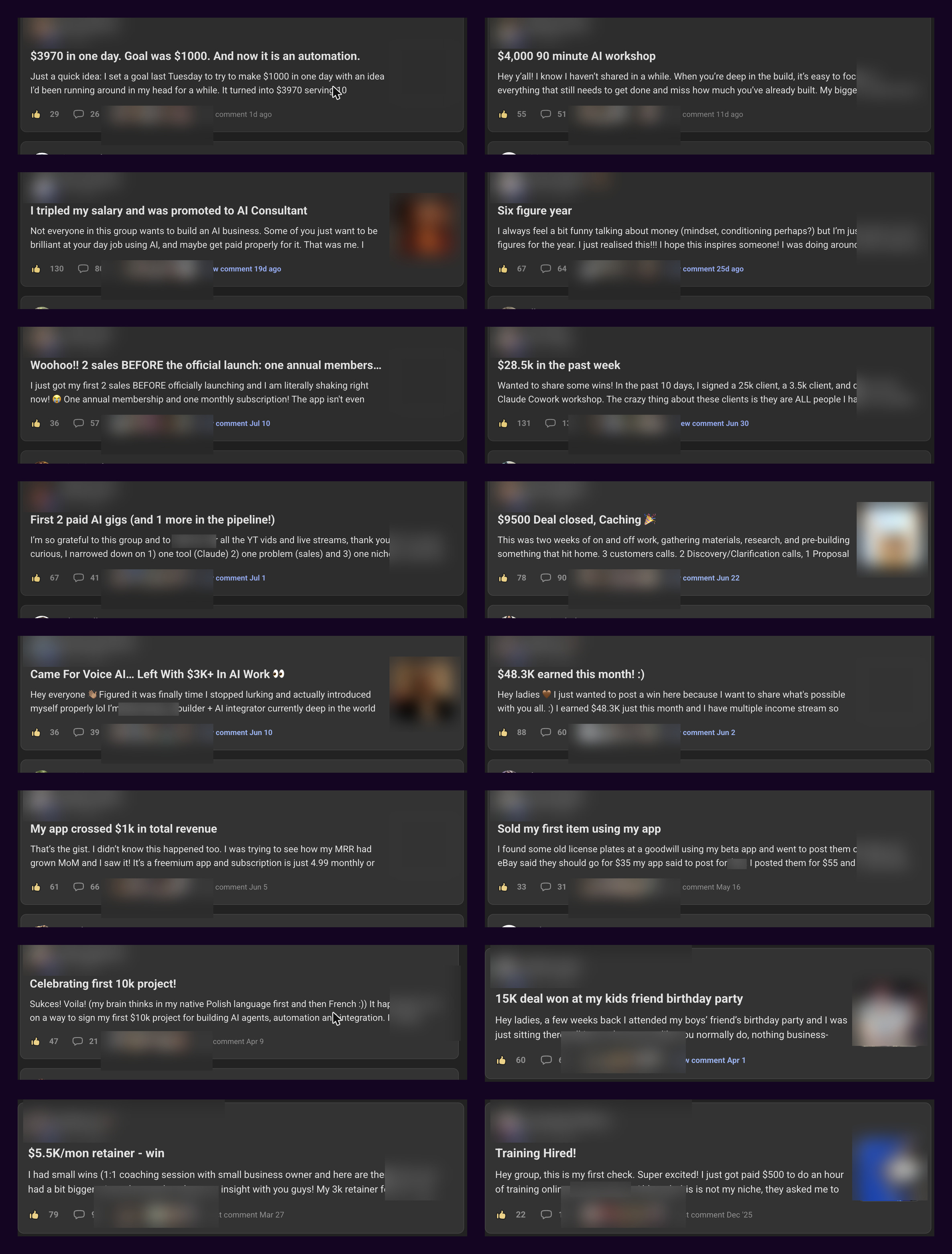
If you’re wondering whether regular people pull this off, here are wins members shared in my free Women Build AI community:
How to choose if you can’t decide
Ask yourself 2 questions.
Question 1: Do you need money in the next month or two?
If yes, pick one of the service paths (1 through 9). You do the work for a business, and you find that business by reaching out to people directly. That means cold DMs, cold emails, or applying on Upwork. You don’t need followers for any of this, just ONE business owner with a painful problem and a DM that shows you’re willing to OWN that problem until it’s fixed.
If you can run a marathon instead, look at paths 10 through 14. These build an audience or a product that many people pay for. In my experience they take 1 to 3 years to get going. It took me about 3 months to get my first viral video (by “viral” I mean 10k views lol). Yet, when I started creating content I gave myself 5 YEARS. That’s the mindset you need - marathon.
Question 2: Are you okay messaging strangers?
Some people are fine with outreach. Others would rather have customers come to them.
That’s me, 2nd one. Even though I did canvassing in high school, knocking door-to-door asking for money, I’m introverted and do not actually want to talk to you.
Neither one is better. But be honest with yourself:
Because the paths to quick money mostly run on cold outreach, while the longer-term paths mostly run on posting content every single day.
Most people who get big end up doing both eventually. For now, you’re picking where to START.
Then match it to what you’re already good at.
If you like teaching people, look at Path 1. If you can write or edit, start with Path 2. Research nerds tend to like Path 3, and if you’ve already managed ad budgets for a company, Path 4 easy.
If you love organizing messy stuff, go with Path 5 or 7. Path 6 is for people who enjoy setting up tools and testing them. If you have years of experience in one industry, look at Path 8, and if you can code, Path 9.
If you can see yourself posting for 1 to 3 years before it pays, that’s Path 10. Path 11 is for when you already have a method people keep asking you about, and Path 12 pairs well with Path 10 once you’re posting. Paths 13 and 14 are software, and I’d only start there if you already have an audience or a technical background.
Still stuck? Pick the one that sounds the most fun, because you’re far more likely to stick with something you enjoy.
I assure you ANY of these paths can be scaled to $20k/month and the playbook is not complex.
Part 1: Get paid this month by doing the work for someone
These are the fastest ways to your first dollar. You sell a service, the client sees the result, and they pay you.
Path 1: Teach a team how to use AI
So many companies buy AI tools because everyone on X is hyping them, and then nobody on the team uses them. Most businesses are at level one out of five when it comes to AI. They installed ChatGPT a few months ago and typed in some prompts. If you’re reading my newsletter, you’re in a tiny bubble of people who know far more than that.
That gap is your business. You teach a team how to finish their everyday work with an AI tool their company already allows.
Keep it simple. Show them one AI agent, a few handy prompts, and how to organize their work so the AI can help. Use their kind of work in the examples. A good pitch is “I’ll train your team on Claude in one day so each person saves hours every week.”
Business owners always want to save time and make more money, so lead with that.
For example, Boon Kgim Khur charged S$288 per person for his beginner Claude Code workshop, even though Singapore has lots of subsidized AI courses (post).
People always ask me what to charge for training and consulting. My answer is always the seame:
the highest number you can say out loud without laughing.
Training/consulting really only scale to high numbers by going after richer clients and charging higher prices. That is the entire growth playbook for this type of services work.
To start, message former coworkers and ask which teams have AI accounts but barely touch them. Then send whoever runs that team a short sample lesson. You can also pitch a local trade association or a professional Facebook group and teach the exact thing their members need. Also, announce what you’re doing on social media - you NEVER know who’s watching/reading/listening and may reach out.
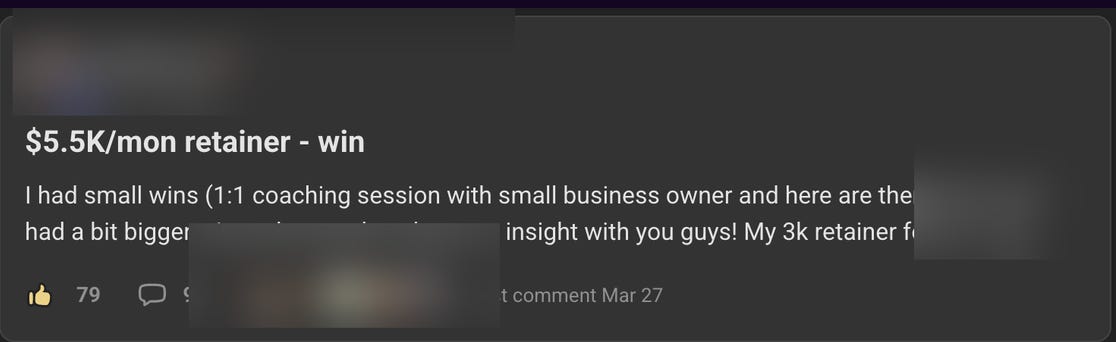
One workshop often turns into more work afterward, like setup help, practice sessions, DFY builds/automations, or a monthly retainer. Here are a few training and coaching wins that members shared in my community:
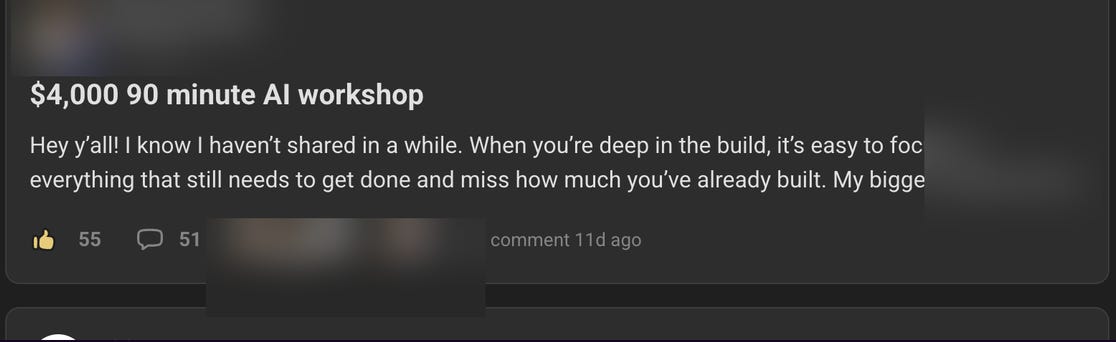
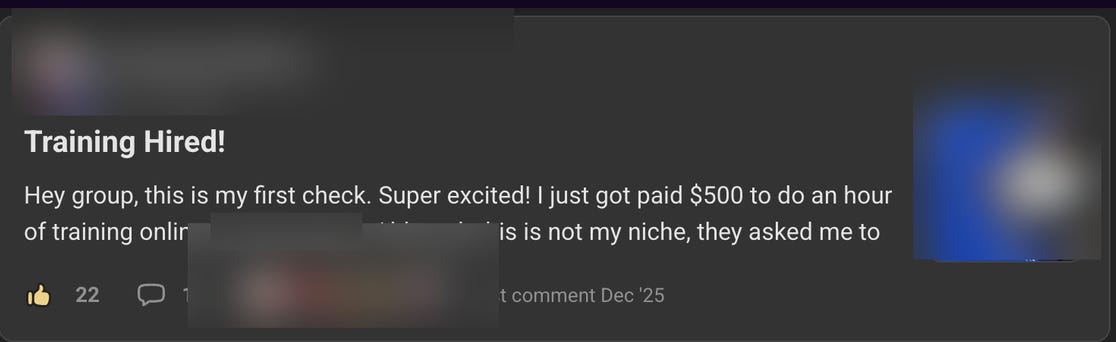
You can do the same thing as 1-to-1 coaching or a paid talk. For speaking, send the organizer a short recording of you teaching plus what the audience will walk away with.
Pick this if you like helping people learn.
If the client would rather you do the work for them, that’s the next path…
Path 2: Make content for busy business owners
This one’s close to my heart because content changed my life.
(Now approaching 4 million followers…)
When I started 2.5 years ago, I did one LinkedIn post a day, nothing else. Eventually I tried a couple of TikToks a day, inspired by BrandNat and KyleBalmer, the OGs of AI Tiktok.
But what about Instagram, Facebook, YouTube, Threads, Substack? Most business owners and creators have the same problem. They have great recordings and expertise sitting around, but their socials have gone quiet.
You take what they already made and turn it into content for them. In other words:
ONE webinar becomes —> 30 LinkedIn posts and shorts.
ONE YouTube tutorial or podcast —> 30 Instagram reels.
The mistake I often see is pitching a single task, like “I’ll edit your videos.” That’s nice, but what they want is to grow without doing any extra work.
For business owners like myself, we DO NOT WANT to orchestrate multiple tasks across multiple people. The complexity and communication overhead of is often not worth it.
Pitch the desired outcome, for example: “I’ll help you hit 100k followers on 3 platforms and you don’t have to do anything.”
The closer your pitch gets to the DESIRED OUTCOME, with as little work required for the business owner, the easier the sell.
For example, @david_bassey_ charged his first ghostwriting client $250/mo, and charged the second client $800/mo after documenting results for the first one on X (post).
Start by finding a business whose social media is struggling (should be easy, that’s 99.9% of businesses). Then, make a private sample from their public info and DM it to them. Lead with proof you know what you’re doing - in this case, personalized work samples because you don’t have proof/testimonials from others yet.
I know cold samples get people hired because I’ve hired from a cold DM myself. One of my video editors DM’d me a work sample and I thought, “Oh, this is awesome. You’re hired.”
I decided on the spot.
Once you have clients, Blotato handles the repurposing and posting everywhere so you’re not uploading to 7 apps by hand.
Avatar videos, product images, translated clips, whatever.
Make them once, check the quality, then distribute EVERYWHERE.
Pick this if you like making content.
Then recycle the same content again, repackage, remix it.
If the client’s content is good but people can’t find them when they search…
Path 3: Help businesses show up in Google and AI answers
SEO means helping a business’s pages show up in search results. AEO (answer engine optimization) means helping them show up when someone asks ChatGPT or Claude a question. SEO has become AEO, so I use the terms interchangeably.
I interviewed Sandy Lee on my channel. She’s a mom of three with a full-time job and no tech background, and she got to $48K in one month from a mix of income streams. One of them was AI SEO consulting. She told me she went on Upwork and applied to AI jobs she didn’t know how to do yet, then had ChatGPT teach her AI SEO. She got a blog automation client and learned on the job.
For example, @MrSulcs charges €1,000 to €3,000 a month for local SEO retainers and around €950 to €1,450 for a standalone SEO strategy (post).
First, pick ONE archetype, like dentists or SaaS founders, and list 10 businesses. Read their reviews and think about what buyers keep asking. Then compare that to their website. Find ONE question their site doesn’t answer, write a short sample rewrite of that page, and show the owner.
Google’s guidance says normal SEO practices still apply to its AI search features. And with the owner’s permission, Google Search Console shows you how their pages are doing in search.
Fair warning, results here can be slower and a lot of it is out of your control. BUT local businesses and fast-growing startups all care about showing up on the internet where buyers search.
I have a full SEO guide for beginners:
AI SEO for Beginners (Full Playbook!)

TLDR: AI SEO, also called AEO or answer engine optimization, is how you get your brand named inside ChatGPT, Claude, Perplexity, and Google AI Overviews. Old SEO won you a blue link. AI SEO wins you a mention in the answer. Here’s the full playbook, beginner to advanced, with copy-paste prompts for every step.
It only boils down to a few things:
pick 1 consistent positioning
post articles that answer buyer questions
build up backlinks from other websites/podcasts/blogs
Pick this if you like the puzzle of how to show up in AI.
If the business wants results faster than SEO can deliver, that’s paid ads, and now you’re spending their money…
Path 4: Run ads for a business that already sells
This is managing ad campaigns for a business whose offer already sells. Making the ad itself is Path 2. Here you decide where it runs, how much it spends, and whether it keeps running.
Start by looking up businesses already advertising in the Meta Ad Library. Pick an business and show them sample creatives built on their offer. Or partner with someone doing Path 2 who needs help running ads.
Only pick this if you already know how to manage paid campaigns.
Or just be transparent with people that you’re starting learning but will figure it out and be accountable.
Those first 4 paths all give the client something they can look at, like a lesson, a post, a page, or an ad. But a great ad is wasted if nobody handles the leads it brings in. The next five move inside the business…
Part 2: Keep a business running behind the scenes
These are services that keep going after the first project. The good news is you can charge every month. The bad news is you’re on the hook every month.
Path 5: Clean up a business’s messy workflows
Most businesses are a complete mess on the inside. Their data is everywhere, their systems don’t talk to each other, and nobody wrote anything down. They’re profitable anyway, because everyone got used to doing things by hand.
The owner usually wants an AI assistant, but their own data/files/systems are a mess. You HAVE TO fix the data/inputs first. Clean up one source of information, then automate one narrow workflow, like a morning email summary or a weekly report.
A full AI automation agency is a lot more work than it looks. You do the audit, pick the tools, build it, and fix it when it breaks.
I’m technical and honestly… I wouldn’t start here.
If you love making messy things repeatable, however, then you’re weird. I mean, start small and it can definitely pay off.
I’d start with a creator’s video that says “comment this word to get the playbook.” The people who commented raised their hand. Most of them will never set it up themselves because they don’t have time. That’s who you DM, and you offer to do it for them. Be respectful and don’t spam the same creator’s comments.
Pick this if you like building automations and debugging.
Once your system starts talking to the business’s customers, the bar goes way up…
Path 6: Answer customers for the business
This path is about answering people who are already trying to reach the business. Someone calls a dentist after hours for an appointment, a viewer comments asking for a link, or a customer has a simple question.
You set up the AI that answers, plus a clear way to hand anything weird to a real person.
First, ask local owners what happens to their missed calls right now. Set up a test phone number running on their public info, let them call it, and propose a small pilot. Retell’s Cents case study shows this exact service running reception for laundromats.
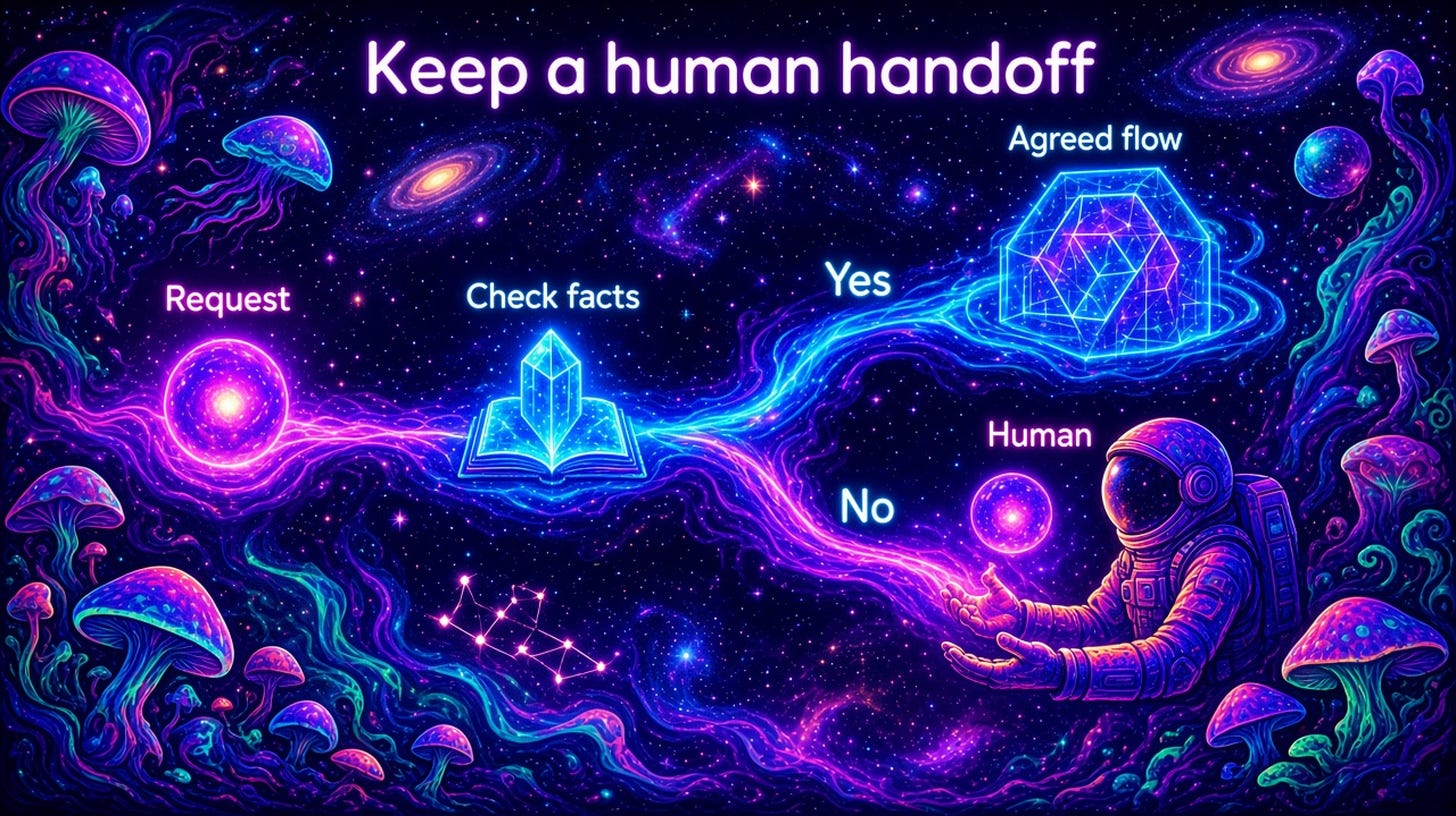
The handoff to a human is part of what you’re selling. Test it as carefully as the AI’s answers.
For Instagram and Facebook comments and DMs, Blotato’s DM tools handle most use cases. For support, start with the help system and answers the client already has. Keep their CRM and conversation history up to date… because that’s part of the job too.
Wrong answers and missed transfers directly hit revenue, so you need to respond fast when something breaks.
Pick this if you can test what goes wrong and you’re quick to fix it.
Some owners don’t want to touch any system, even after you install it. They want you to own the work…
Path 7: Be the person who handles it every week
Here you take a recurring job off the owner’s plate and use AI to do it faster. Think sorting new requests, drafting follow-ups, or preparing company updates ready for Monday.
I’d pitch a busy founder with:
“I’ll do it for you. You don’t have to touch anything.”
As a founder, I get DMs every day that say some version of “here’s a cool thing you could set up.” That’s nice, but I still have to do all the work… so NO THANKS!!!
The ones that get my attention offer to take it off my plate.
Completely.
Busy founders love to throw money at problems.
But not TIME.
We don’t have any of that.
Please understand this and you will be wealthy.
Do the job by hand first so you know what good looks like. Then automate the boring repeat parts and oversee it running.
The difference from Path 5 is who does the work.
In Path 5 they pay you to build a setup.
Here they pay you every month to get the work done.
Pick this if you like dependable routines and you can be reliably available.
After you’ve seen enough of these workflows, you’ll be able to tell owners which ones are worth fixing first…
Path 8: Advise a business on where AI fits
An AI consultant helps an owner figure out where AI will save time and money, and what to do first.
Most consultants start with an audit. You learn what the company does, what tools they use, and how the teams work together. Then you recommend where AI fits. Sometimes the right answer is “leave this alone, AI won’t help here,” and a good consultant says that.
Consulting is a little harder to get into if you’ve never done it and don’t have work experience in an industry. But it teaches you amazing skills, like how to sell and how to set expectations, and once you know how, it’s one of the fastest ways to cash. Anytime you need cash.
If you have a slow month, you can always go grab another consulting client.
Start with an industry you’ve worked in, then DM owners on Instagram and LinkedIn. I’m serious about volume here.
When people tell me they DM’d 10 people today, I ask why they didn’t set aside 4 hours and sit there sending 200 DMs.
The bar is low.
Honestly, people just won’t do it…
So, if you JUST DO IT… you’ll get results.
Sadly that simple, but courses overcomplicate all this so you keep buying stuff you don’t need.
Write a DM that isn’t total AI slop and mentions their business.
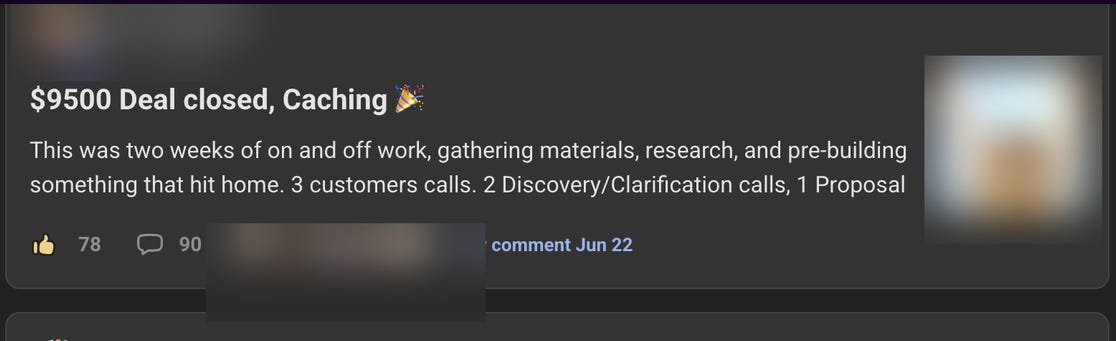
After the audit, some clients will want you on a monthly basis for things like staff training and checking whether people use what you built.
Price that separately from the audit.
Pick this if you have enough experience to tell a client their idea is bad.
Sometimes the audit shows that no existing tool can do the job. That means custom software, and maintaining the code too…
Path 9: Build or fix software for one client (ADVANCED)
New to software? Skip this one. Path 1 or Path 2 is a much easier place to start.
Here you build or repair a small tool for one specific business. A common one right now is a founder who vibe coded an app that runs fine in the demo, until the first customers can’t get through signup.
To get clients, help people with specific problems in founder groups, or partner with an agency that needs someone to fix things. Show a demo, then sell the diagnosis first and quote the fix after you’ve seen the code. Hidden bugs make big fixed-price promises risky.
If you’re testing AI features, turn the failures you find into checks you can rerun every time you change something.
Pick this if you enjoy vibe coding.
All 9 of these paths so far mean doing work for one client at a time. If you keep solving the same problem again and again, see whether one thing you make could serve lots of buyers at once…
Part 3: Build something lots of people pay for (the slow burn)
These scale much better than services, because one asset can serve tons of customers. But they take longer, because you need an audience, trust, or a product people want.
The biggest mistake I see is picking one of these while you need cash asap.
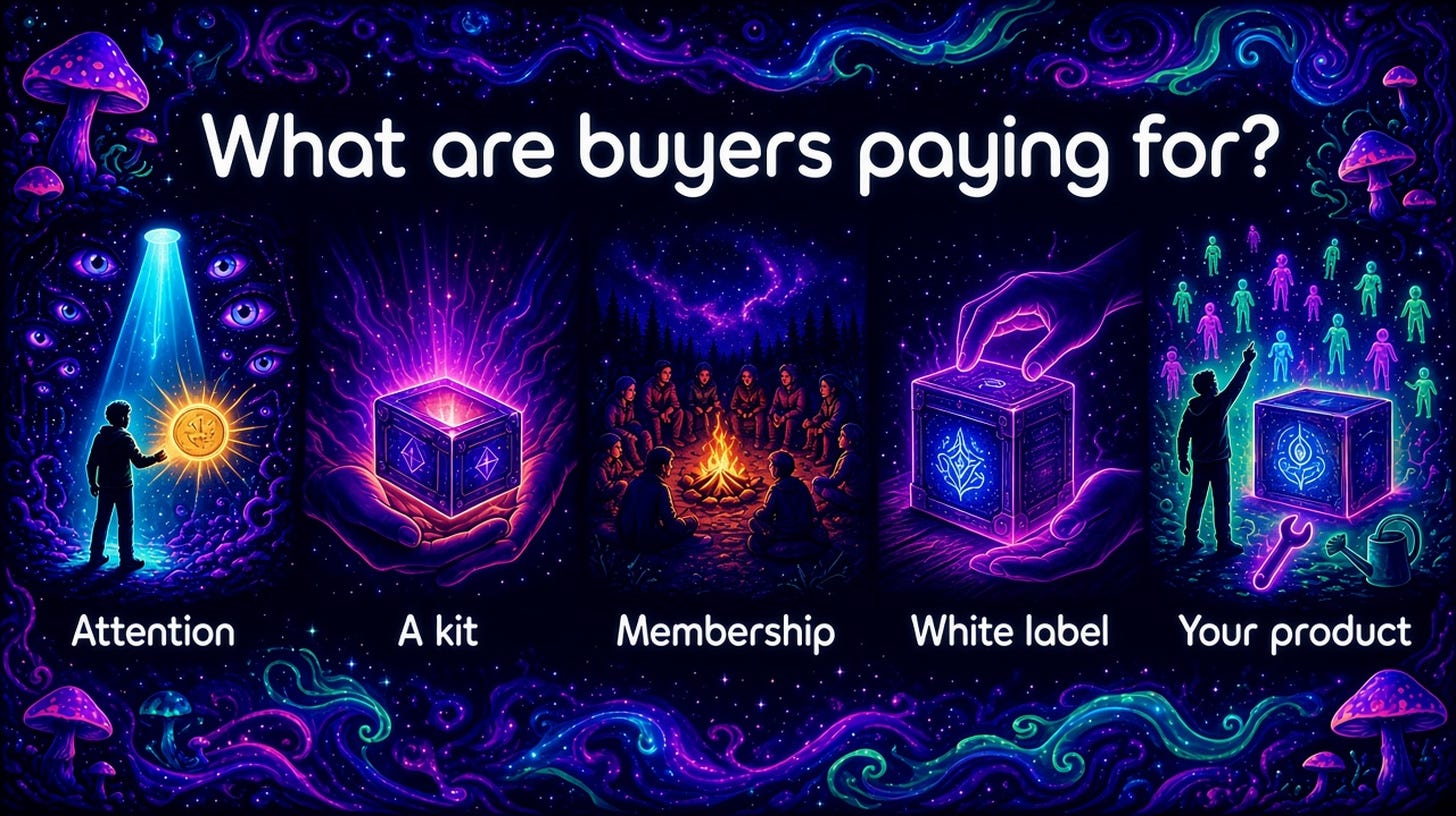
Path 10: Build an audience and get sponsors
Building an audience is what I do, though I don’t take sponsorships myself. Film yourself talking to a camera, post it on social media, and share useful tips.
You don’t need crazy deep knowledge.
Most AI education out there is just basic.
Literally, creators just ask ChatGPT/Claude “ELI10 explain this feature” and that’s your entire script.
The help docs for any AI tool are 100 videos’ worth of content.
Learn something on day 1, share what you learned on day 2, and repeat. I call it learning in public.
You don’t have to pretend to be an expert.
Say “I’m learning this, here’s what worked and here’s what confused me.”
The shortcut is to copy hooks that are already getting views. Search a hashtag on TikTok or Instagram, watch the viral videos, and copy the hook word for word, the first 10 seconds.
BTW you have my full permission to copy my videos.
I think by now I’ve seen hundreds of AI educators get started by copying my content.
You’ll feel weird about it at first, which means you have a moral compass, but over time you’ll find your own style.
Post a lot.
Most of your posts will flop in the beginning and that’s normal. Every post is a data point, so if you post 3 times a day on Tiktok, you learn 3 times faster than someone posting once.
You can take one video and post it on TikTok, Instagram, YouTube Shorts, and Threads, and that’s 4 posts already.
Once you hit around 10,000 followers across platforms, sponsors start reaching out on their own. AI startups want attention, and they’ll pay you to make videos about their tools.
For example, Nishant Chahar’s first YouTube sponsorship paid ₹7,000 from InterviewBit (post).
On day one, pick one platform (I’d start with TikTok or Instagram, since a brand new account can do well) and post 2x per day. Cross-post to other platforms.
Then as you build the habit of posting daily, pitch a relevant company with one specific video idea.
Pick this if you can keep posting for 1 to 3 years before it pays.
When the same questions keep coming in from your audience, you’ll see what people want fully solved. That’s where a paid product starts…
Path 11: Sell a digital product
A digital product packages up your method so people can use it without booking you. That could be a template, a guide, or a short lesson.
People are paying for a shortcut. They don’t want to dig through a million confusing tutorials, so you save them the time.
If people keep asking for your client-update template, I’d package that one thing before recording some huge course.
Right now, AI video editing skills are actually selling. So that’s one real idea for a digital product.
Start by going back to the people who already asked how you do the thing, and offer them the small kit. Use a checkout like Gumroad, and check fees and availability in your country first. A saved AI skill file can go in the kit too. Say which tool it’s for.
I give all my own AI education away for free.
This path is for you if you have a useful know-how to sell.
Pick this if the problem is mostly the same for every buyer.
If people need fresh updates or ongoing feedback, a one-time kit stops being enough…
Path 12: Run a paid community or newsletter
Here you deliver new value on a schedule. That could be a weekly research newsletter, a community, or both.
Communities are the one I’d pick if I had to start from zero with no audience and no technical skills. I’d post content while I learn, then launch the community. One reason is that they’re recurring. Courses get a bad rap because people pay once and then nobody cares about them. A community has ongoing lessons, live calls, and a place to ask questions. The biggest thing is the wins. When new members join and see other people succeeding, that’s hard for anyone to copy.
The founders I see with the biggest communities built a following first, then launched. This pairs well with Path 10.
For example, Duncan Rogoff recently $100k monthly recurring revenue, largely from his Skool community on Claude. (post)
First, pick one profession or group with a shared problem. Share a few free sample issues or lessons with them, ask what they used, and then offer a paid version built around that. You can use Substack for publishing and Skool for communities.
You don’t need a community just because you have a newsletter.
My Women Build AI community is free.
Paid is just one option for your own business.
Pick this if you want a repeat income AND repeat commitment.
If people would rather have a tool that does the task than more guidance, you’re selling software access next…
Path 13: Resell software under your own brand
White-label means you sell another company’s software under your own brand, and you handle setup and support.
The supplier builds the product.
You still have to win customers and help them use it.
I’d start with a business whose workflow you already helped with in Path 5, 6, or 7. Then check whether other businesses in the same industry need the same setup. Before you quote anyone, get the supplier’s resale terms and pricing in writing.
Keep in mind an owner can usually buy the tool directly, so they’re paying you for your setup and support for their specific industry.
Pick this if you want to sell and support software without building it.
A quick note if you’re picking Path 2 or Path 13
I’m celebrating being featured in 3 books with the 3-Books Celebration Bundle. Use code 3BOOKS for 50% off your first month of Blotato, plus 5,000 bonus AI credits and early access to whitelabel and resell Blotato.
The bundle expires November 30, 2026.
If a supplier’s limits ever stop you from delivering what you promised, the other option is to own the product yourself…
Path 14: Build your own software product (ADVANCED)
Starting from a blank chat box with no audience? Skip this for now. Deliver the task as a service first, or team up with someone technical.
This is the path I chose with my own app. I built an audience first, and I had the problem myself in my own work. I think this is the hardest path on the list. Vibe coding makes it easy to build fast. It doesn’t make it easy to build something good, and it definitely doesn’t get you users.
2 mistakes kill most vibe-coded apps.
The first is making version one way too complicated. Your app should do one thing very well in the first 90 seconds after someone signs up. If you can’t describe it in one simple sentence, it’s doing too much.
The second mistake is not doing marketing. While you’re building, 90% of your time goes into the product. Once you launch, that has to flip to 90% marketing until users are coming in steadily. People come to me all the time asking why nobody uses their app, and I ask what marketing they’re doing. Usually the answer is none.
Before you build anything, watch 10 people do the task today. Then, vibe code a simple version and show them and say it costs “$xx/month”. If nobody pays, ask why.
I’ve shared how I built and rebuilt Blotato if you want the full story.
Pick this if you want the long-term job of owning a product. Personally, I like building products because I’m introverted, so things like consulting (babysitting), speaking (ughh), and 1:1 coaching give me anxiety.
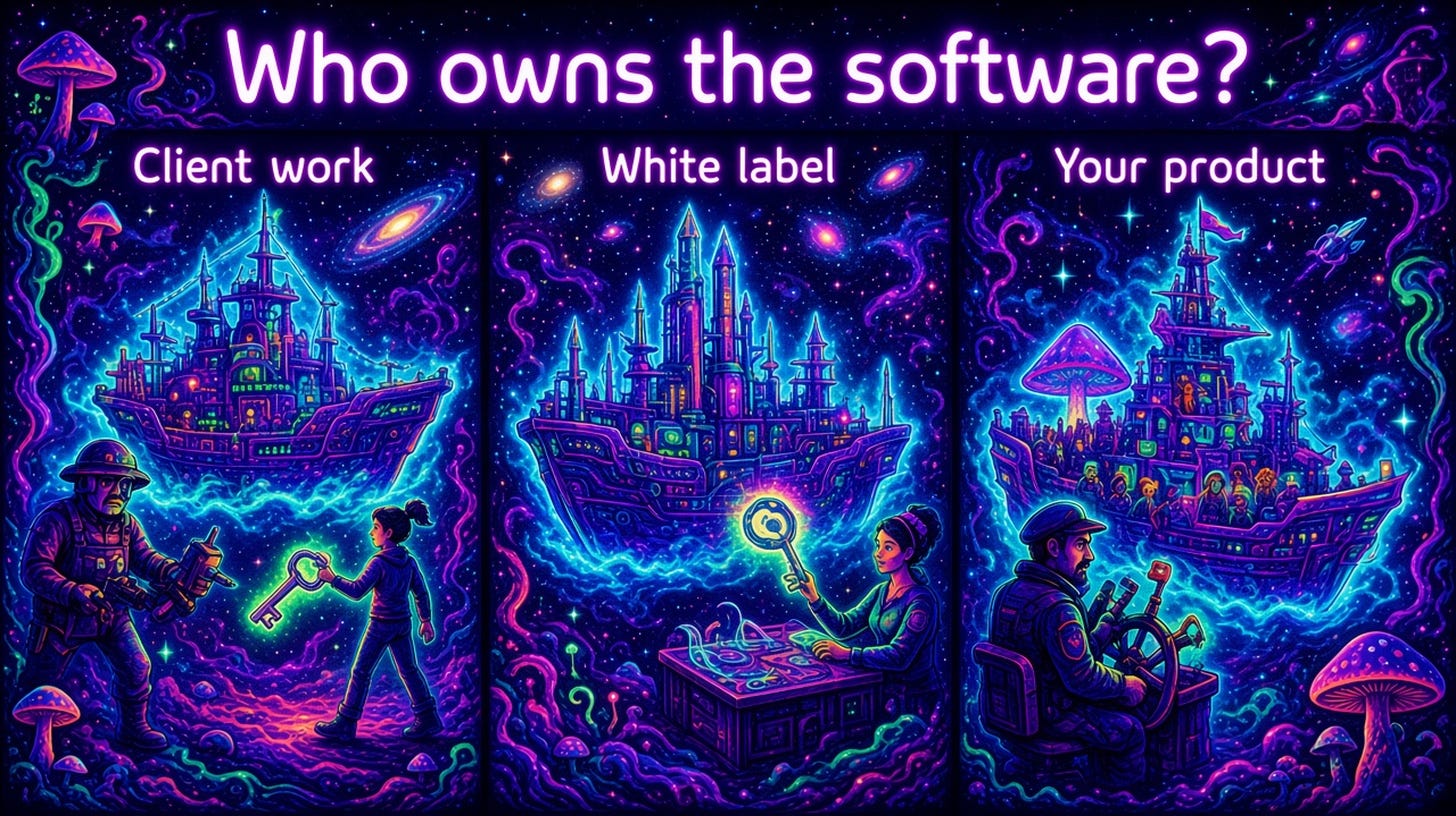
These are separate businesses because you own different work, costs, and promises to customers.
That’s all 14.
Before you go all in on ONE, do a quick check on your TIME.
Don’t tell me “I tried for a whole month!” when you actually tried it for 30 minutes per week!!!
You know who you are.
I’m watching you.
Get your first paying client this week
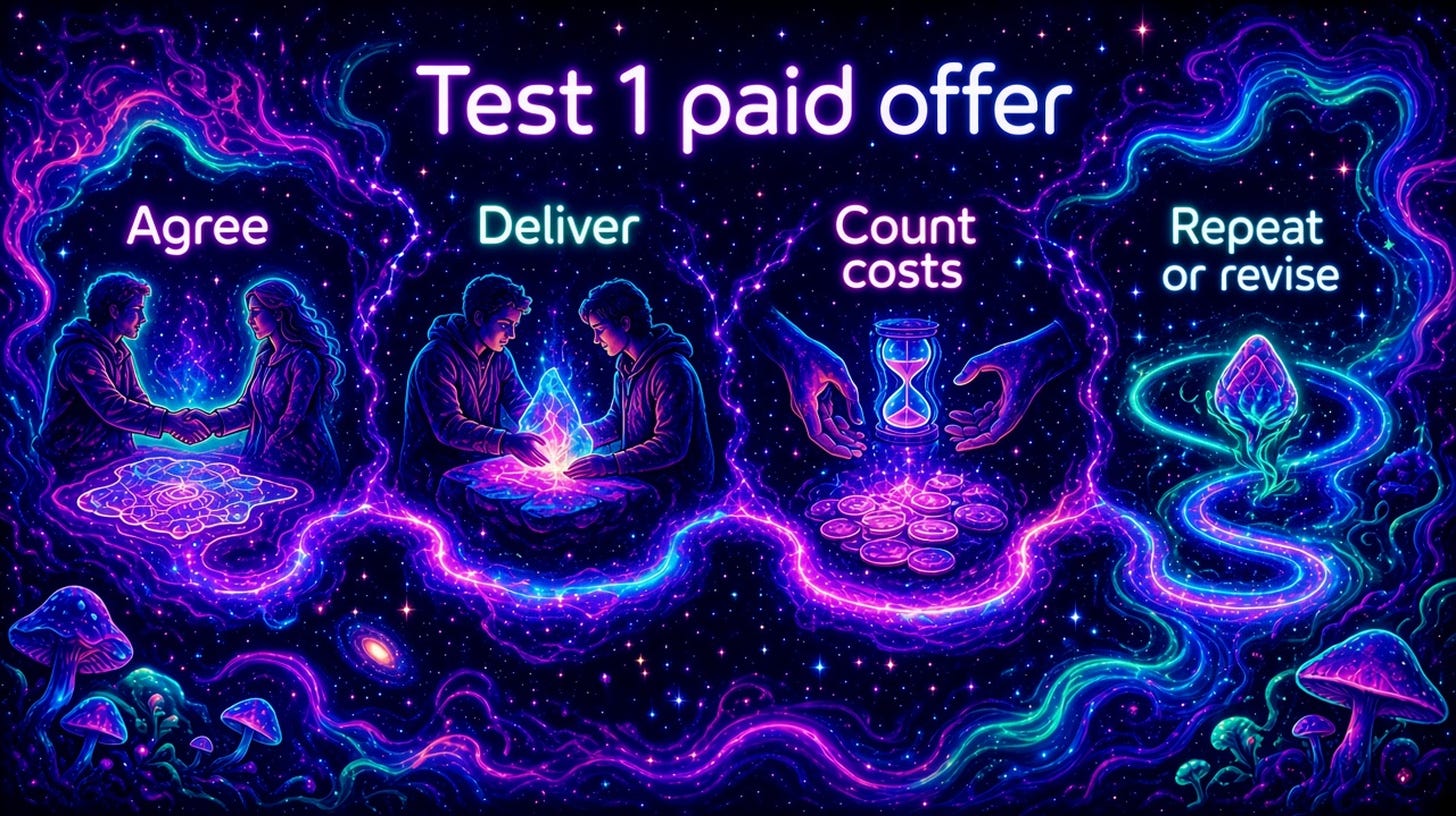
A paid pilot is a small, clear first job with a paying buyer. It’s the fastest way to find out if people will pay for your offer.
Step 1: Write your offer before you buy any tools
Fill in this template:
I help [specific buyer] finish [specific task].
For this pilot, I’ll deliver [output] by [date] for [price].
It includes [number of revisions] and needs [inputs] from you.
We’ll know it worked if [what success looks like]. Ongoing work is a separate choice.
If you can’t fill in that last line, make the job smaller. “Use more AI” has no finish line. “Turn these meeting notes into a client update” does.
Step 2: Make small proof
Use your own files or any material you’re allowed to use. For content, show a finished post next to the original recording. For training, record a short lesson someone can follow (or just post on social media to kill 2 birds with 1 stone). If it’s a system, show it actually running.
Step 3: Go where your buyer already hangs out
Start with the first step I gave for your path.
If it’s someone you know, explain what you do and ask if the problem is real for them right now. If it’s a stranger, lead with something useful about their business. Here’s a DM for the content path:
I saw your video about [topic] and it got me thinking. So, I made a private [blah blah] that I think could help you save 10 hours/week.
Here it is: [blah blah]
Volume matters a lot here. If you DM 200 people and 20 reply, you’ve got 20 data points on how people see your offer and your price.
If you DM 20 and 2 reply, you’ve barely learned anything.
If your path uses Upwork, apply to FRESH jobs within the first few hours. Speed is by far the #1 lever.
When you get ghosted, send the next DM anyway. Silence after you say a price usually means they’re doing math, checking budget, or asking someone.
I’ve said yes to people 2 months after ghosting them because I was thinking it over.
Or most commonly, they just didn’t see your message. You realize I get a BILLION messages a day, right?
Don’t send the same generic AI slop pitch to everyone and call it market research :) I call that “excuses”.
Step 4: Figure out what’s missing
If nobody replies, check whether you reached the right people and whether your message was specific. If you’re getting replies but no next step - that means the problem is NOT painful enough for them to act.
If you’re getting meetings but no payment, ask what makes the offer hard to trust or buy, whether that’s the scope, your proof, the price, or the timing. If they pay but the delivery goes badly, fix your process before you sell more.
Change one main thing, then try again with a fresh group of people.
Step 5: Agree on the finish line
Before you start, write down what you’re delivering and when, what you need from the client, how many revisions are included, payment terms, tool costs, and how you’ll both know it’s done. Take a deposit.
Then track how long the job took you, including the parts you forgot to price.
But most importantly, don’t worry about getting everything perfect.
The perfect DM, the perfect content, the perfect offer, the perfect website, the perfect price, the perfect proposal.
IT DOESN’T MATTER HOLY SH*T
Just GET STARTED with 1 client.
Not Sure Where To Start? 👇
I’ve organized my best trainings below:
Subscribe to my Youtube and hit the “notification” bell
So that you never miss my free trainings 👇
IMPORTANT: I will NEVER ask you for money. I am NOT sending you friend requests. I am NOT on Whatsapp, Telegram, or messaging apps. I will NEVER sell a course. Always block & report scammers.
Totally isn't it so crazy how many of these sound simple on paper and then you actually try one and it's like okay wait this is a whole business now. I was literally talking to a client this morning about which tool to start with and they kept jumping between like five different ideas. And I kept saying just pick the one you can actually stick with for a month and post about it every day and see what happens. Because the ideas are not the hard part anymore, the sticking with it is. And low key that's what I keep coming back to with the agents stuff too, like the tools are everywhere now but someone still has to show up and do the boring reps and talk to real people. And the ones that work for me are always the ones where I can actually see myself doing it on a random Tuesday and not just when I'm motivated, you know?